 Zeynep Conkar
Nearly $65 million in advertising, most of it funnelled through AIPAC on behalf of Rep. Haley Stevens, failed to stop Abdul El-Sayed from winning Michigan's Democratic Senate primary this month, dealing a major blow to the pro-Israel establishment that backed Stevens.
El-Sayed ran on calling Israel’s war in Gaza a genocide, breaking with Stevens and much of the party’s donor class, but voters chose him over a sitting congresswoman backed by the state’s governor.
Congress has been arriving at a version of the same verdict for months, if more unevenly.
In July, 103 House Democrats voted for an amendment introduced by Kentucky Republican Thomas Massie to strip $3.3 billion in military aid to Israel, a vote that only 37 Democrats had been willing to cast two years earlier.
In April, 40 of the 47 Senate Democrats voted to block a $450 million arms package over Israel's conduct in Gaza and Iran, up from 27 the previous July and 15 the year before that.
Each of these measures failed, but each failed by a narrower margin than the last.
Since October 2023, Israel has killed more than 73,000 Palestinians and wounded over 174,000, according to the territory’s Health Ministry.
The scale of the destruction has been visible around the world in real time, with entire neighbourhoods reduced to rubble, mass displacement and forced starvation conditions documented across the enclave.
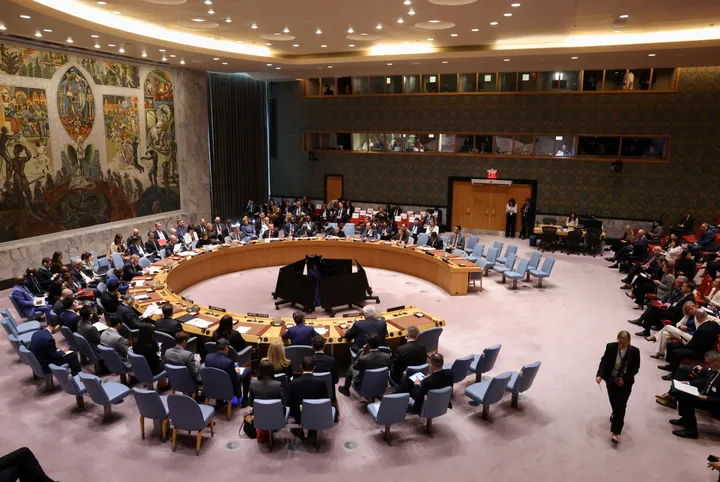
After nearly three years of the war, more and more US lawmakers are openly calling out Israel over the Gaza genocide, even as party leadership on both sides struggles to keep pace with its own members.
The support for Israel is also eroding among American Jews, according to Alon Liel, former director general of the Israeli foreign ministry.
“I think the change in the US is triggered mainly by American fatigue with the Israeli-Arab conflict and the fact that Israel is no longer the underdog,” Liel tells TRT World.
“It has worsened as a result of the casualties and damage inflicted on Gaza and illegal settler violence in the occupied West Bank.”
What voters already believe
Congress, in this sense, is following public opinion, which moved first.
An Economist/YouGov poll conducted in August found that 45 percent of American voters believe Israel is committing genocide against Palestinians, against 31 percent who disagree, and this margin holds across Democrats, independents, and self-described moderates alike.
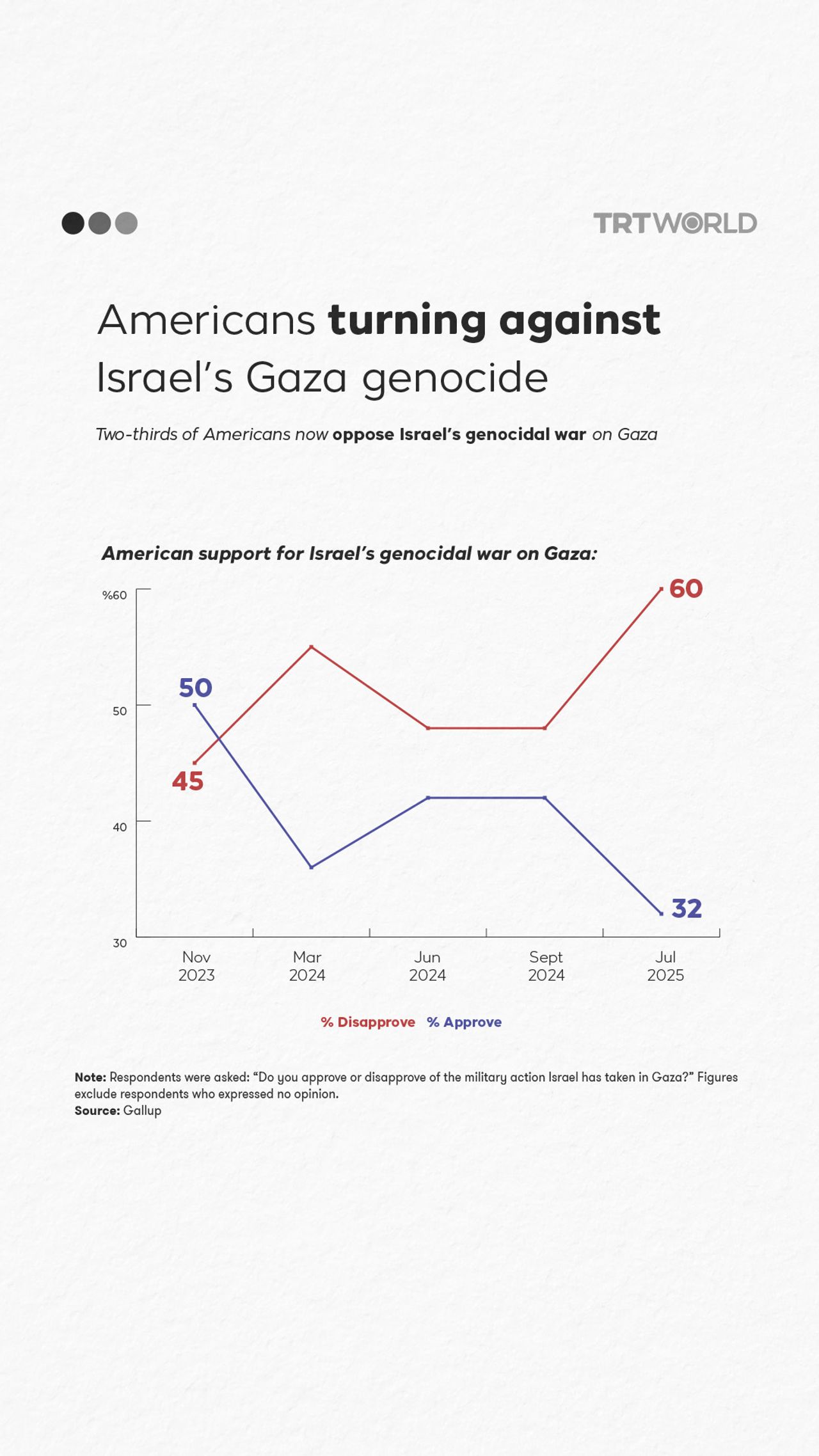
Gallup has tracked approval of Israel's genocide in Gaza falling from 50 percent to 32 percent since the campaign began, while disapproval climbed from 45 percent to 60 percent over the same period.






The steepest collapse has come among Democrats, whose support for continued military aid dropped from 55 percent to 43 percent in a single year, while their approval of Israeli conduct in Gaza has fallen to just 8 percent.
Set against the longer historical record, the shift looks like a genuine reversal, decades in the making.
In 2001, more than half of Democratic voters said their sympathies lay with Israel, against 16 percent who sided with the Palestinians; those figures have essentially inverted, with 59 percent of Democrats now siding with Palestinians against 21 percent for Israel.
Republicans have moved considerably less, but the movement among younger Republicans is measurable all the same: unfavourable views of Israel among Republicans under 50 rose from 35 percent to 50 percent over three years, a shift driven largely by fatigue with US intervention in another Middle Eastern war.
AIPAC's shrinking floor
For three decades, AIPAC’s influence rested as much on political pressure as persuasion, helping make unconditional support for Israel a bipartisan norm by making any departure from it a genuine electoral risk.
That capacity is now visibly eroding. AIPAC spent more defending Stevens in Michigan than in almost any race in its history and still lost.
It had spent to defeat Cori Bush in Missouri two years earlier and succeeded, but this cycle Rep. Adriano Espaillat lost his own primary to a democratic socialist who ran explicitly against military aid to Israel.
According to Liel, the erosion of support for Israel among American Jews legitimises the broader shift in the US.
“Also, the growing criticism of Israel from Europe is reinforcing the shift in American attitudes. This trend is here to stay until Americans see a change in Israeli policy and behaviour,” Liel says.
“AIPAC is in decline as a result of this and the fact that J Street is counterbalancing it,” he adds.
A parallel dynamic is unfolding within the Republican coalition, in a different key: figures like Tucker Carlson, Marjorie Taylor Greene, and Megyn Kelly have not yet cost a Republican incumbent a seat, but they have made "America First" scepticism of Israel a live position inside MAGA media for the first time in a decade.
Yossi Shain, an Israeli international relations scholar and former Knesset member, described Israel as a “toxic brand” in Washington.
Former CIA officer John Kiriakou was even more direct, saying Israel had “lost the American public” and “lost the American military”, and warning that the US would not fight Israel’s wars indefinitely or be intimidated into silence.
What many now agree on is that the shift is structural; Republicans and Democrats are arriving at the same conclusion about Israel’s genocide in Gaza from opposite ideological starting points, while the institutions that once protected bipartisan support for Israel are struggling to hold that consensus together.