 Yasin Bas
On September 6th, a new state parliament will be elected in Saxony-Anhalt. The AfD is polling at 41 percent there , far ahead of the CDU.
An absolute majority is not out of the question. In Mecklenburg-Western Pomerania, where elections will be held two weeks later, the party is also leading with 36 percent .
Nationwide, the AfD is also the strongest party with 29 percent , while the CDU/CSU and SPD together only reach 34 percent.
The days when the far-right was considered a purely eastern phenomenon are over. It has developed into a mainstream party, which is not good news at all for German democracy.
Nearly 70 percent of Germans expect the AfD to provide at least one state premier after the state elections in September.
Political scientist Werner Patzelt even warns that in the event of an AfD victory, one could expect "weeks of civil war-like conditions" and even "attempted assassinations."
The question is no longer whether the AfD will come to power, but when.
For years, the established parties looked the other way, ducked for cover, and in some cases deliberately ignored people's concerns.
This is precisely what fuelled the rise of the populist party.
The loss of trust in democratic institutions is dramatic: only 36 percent of Germans trust their government, less than the OECD average of 39 percent.
This is the breeding ground in which the AfD thrives.
Why do migrants also vote for the AfD?
A particularly disturbing phenomenon is that people with a migration background are also increasingly leaning towards the AfD.
According to a study by the German Centre for Integration and Migration Research (DeZIM), around 20 percent of voters of Turkish, Middle Eastern, or African origin would consider voting for the AfD.
This seems paradoxical at first glance: A party that labels Muslims as "culturally alien" and demands their "remigration" suddenly finds supporters among precisely those it wants to get rid of.
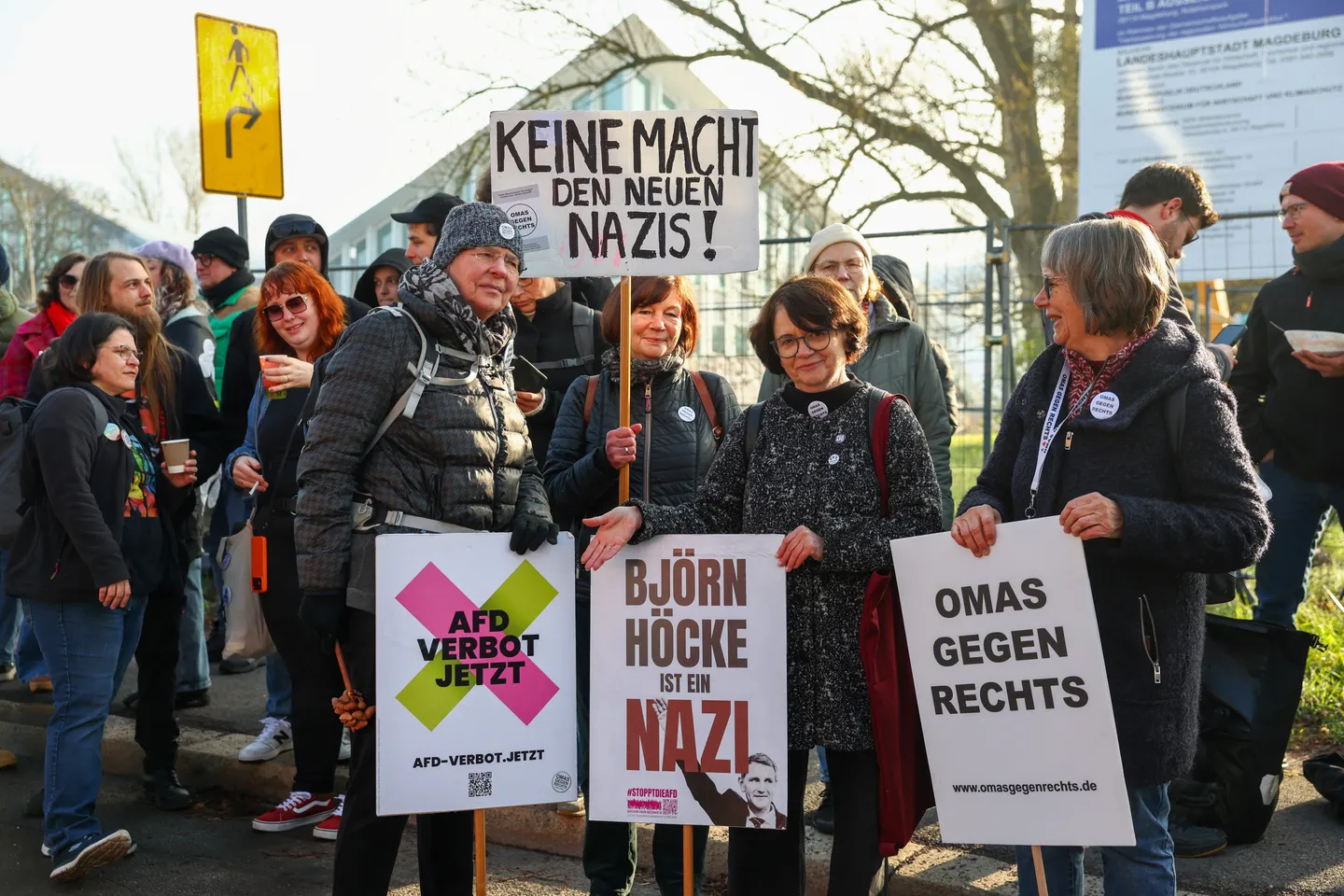
AfD politicians like Bjorn Hocke make no secret of the fact that their rhetoric of exclusion is also directed against Turks.
The AfD parliamentary group leader in Thuringia said in a podcast that the Turkish population in Germany must be significantly reduced because Turks are not culturally assimilated.
To achieve their departure, life in Germany must be made as unpleasant as possible for them. Such ideas should really belong in the dustbin of the Kohl era.
But they are being voiced again. Unfortunately, even within the CDU.
Nevertheless, there is a growing group of migrants who feel addressed by the AfD.
The reason is a perfidious manipulation of fears. Many immigrants who have lived in Germany for decades and have integrated do not see themselves as a target of the AfD.
They distance themselves from "the newcomers," meaning refugees and "unintegrated" migrants. They think: "The AfD isn't targeting me, but the others."
Sociologist Ozgur Ozvatan says that people who “immigrated earlier sometimes later adopt migration-sceptical positions because they say: I had to work hard for this, and those who come after me get things handed to them on a silver platter."
Migration researcher Yasar Aydin sees another reason in the fragmentation of migrant societies.
Those who have lived in Germany for generations and consider themselves integrated fear for their position. They worry that new waves of refugees could jeopardise their hard-won achievements.
Added to this is the feeling that established parties, media, and authorities are neglecting their interests and marginalising them.
In addition, the AfD specifically addresses conservative migrants on TikTok, Instagram and other social media platforms, including messages against "gender ideology", for traditional family images and conservative education policies.
They distinguish between "good" and "bad" migrants. This is a dangerous tactic of division. AfD co-founder and federal chairwoman Alice Weidel campaigned during a visit to Berlin-Neukolln, a district with a large Turkish population.
EU parliamentarian Maximilian Krah is also specifically courting the votes of Turkish and Muslim voters.
But anyone who thinks the AfD doesn't target them is mistaken. In its election manifesto for Saxony-Anhalt, the AfD has made it unequivocally clear that it wants to reduce religious freedom for Muslims to "appropriate standards".
Mosques should no longer be "easily recognisable as opulent oriental buildings." The muezzin's call to prayer is "not indispensable", and the “AfD government will exhaust all possibilities to restrict the influence of this culturally alien religion in Saxony-Anhalt," the manifesto reads.
Islamic scholar and lawyer Mathias Rohe warns that the AfD "makes no secret of its intentions to systematically exclude the Muslim population."
So anyone who believes the AfD will spare them is mistaken. Because racist and exclusionary policies are rarely directed against just one group; they spread and eventually affect everyone who doesn't fit into the AfD's narrow-minded worldview.
Radical and misanthropic
The AfD's proposed "government programme" in Saxony-Anhalt reads like a systematic manual for exclusion.
The party calls for the abolition of the fundamental right to asylum and wants to transform it into a "right of clemency." A "task force for deportations" will be established and the subsidiary protection status abolished.
Political scientist Werner Patzelt, however, downplays the AfD's demands, seeing no immediate threat to democracy.







Nevertheless, in the chapter on ‘immigration and remigration’ of the AfD's government programme for Mecklenburg-Western Pomerania, for example, it is made clear that people from different cultural backgrounds are not welcome.
The AfD wants to protect "German-influenced society" from a "multicultural society." Integration policy is redefined as "migration policy."
Those who help refugees are described as a problem in this programme. The AfD also demands the termination of the Interstate Broadcasting Treaty and the restructuring of public broadcasting into a "basic broadcasting service."
With regard to Islam, the AfD had already announced a radical overhaul of education policy in the run-up to the 2025 federal elections.
The party wanted to abolish Islamic religious education, eliminate Islamic theology professorships at universities, and replace them with a "non-denominational Islamic studies" discipline.
Instead of integration, the government program for Mecklenburg-Western Pomerania includes a demand for "preparatory classes" for children with language deficiencies.
But the AfD doesn't just endanger religious freedom, the media, and education. The party also poses a serious threat to internal and external security, as well as the justice system.
Several interior ministers, along with Federal Defence Minister Boris Pistorius and Foreign Minister Johann Wadephul, recently warned of the consequences of an AfD government.
Thuringia's Interior Minister Georg Maier said: "We cannot allow secret information from our security authorities to leak to Russia or right-wing extremist circles."
The AfD has "numerous contacts with authoritarian states" and is "networked with right-wing extremist front organisations."
Brandenburg's Interior Minister Jan Redmann also said that “if a party that is partly right-wing extremist gains access to security-relevant information, it endangers our security. This is not a hypothetical scenario, but a real danger."
But mind you, AfD voters are not aliens. They are your neighbours, club and work colleagues, family members.
This means that the centre of society has become more radical, and that is precisely what is worrying.
The "firewall" was never a guarantee, but rather a self-imposed obligation by the democratic parties, a consensus that is now crumbling.
For years, the established parties treated migration, Islam, and integration as security issues, not as lived reality. This has poisoned society.
The CLAIM Alliance documented 4,096 anti-Muslim incidents in 2025 alone, an average of more than eleven per day. 75 percent of the Muslims surveyed reported experiencing discrimination in government offices. The German Islam Conference was for a long time a security conference, a fatal mistake. Muslims were often perceived less as part of society and more as a problem.
What can the AfD actually implement?
Many of the AfD's demands fall outside the jurisdiction of a federal state. Abolishing the right to asylum or changing citizenship law are federal matters.
However, the AfD could use the Bundesrat (Federal Council) to initiate legislation and intervene at the state level in matters of education, policing, and administration.
And what about a ban? The hurdles are high, the process lengthy. The AfD would portray itself as a victim. In 1960, the Rhineland-Palatinate Interior Minister August Wolters banned the DRP state branch.
The ban was later lifted, but then reinstated. The NPD ban was also a fiasco. A ban can therefore be counterproductive.
Why has the AfD become so strong? The answer is uncomfortable, but it must be asked.
For years, the established parties failed to take the concerns and fears of the population seriously enough.
Migration was all too often discussed as a threat, not as a social reality. In many places, Muslims were treated as a security problem, not as part of society. This provided fertile ground for the AfD.
The question now is: How does a democratic state governed by the rule of law deal with this new reality?
The firewall alone, however important it is, will not make the AfD disappear. It won't even significantly weaken it.
The success of the right-wing party is an expression of a profound societal and political crisis of confidence. Many people have lost faith in politics because they feel their concerns are not being heard.
The AfD will therefore not only win state-level elections in the future. It is only a matter of time before it leads a government at the federal level as well.
European examples show that right-wing populists have long since arrived in government. Germany will not remain an exception.
Politics must regain the people's trust, not through new bans or exclusionary rhetoric, but through credible answers to the pressing questions of our time.
A democracy that no longer reaches its citizens loses not only trust and elections, but also its legitimacy.
Democracy is not sustained solely by institutions or the firewall.
"It thrives on an ethic of civic responsibility—on people who are willing to take responsibility for the common good, even when it is inconvenient. [...] The history of resistance shows us: people are not born heroes; they learn to take responsibility long before freedom and human dignity are at stake. Tomorrow's freedom is decided by our actions today."
Federal Family Minister Karin Prien pointed this out on July 20 at the Federal Government's central commemoration of the resistance against National Socialism.
Ironically, this took place at the very same location where the AfD also laid a wreath.
(This article was first published on TRT Deutsch)