 M. Fevzi Esen
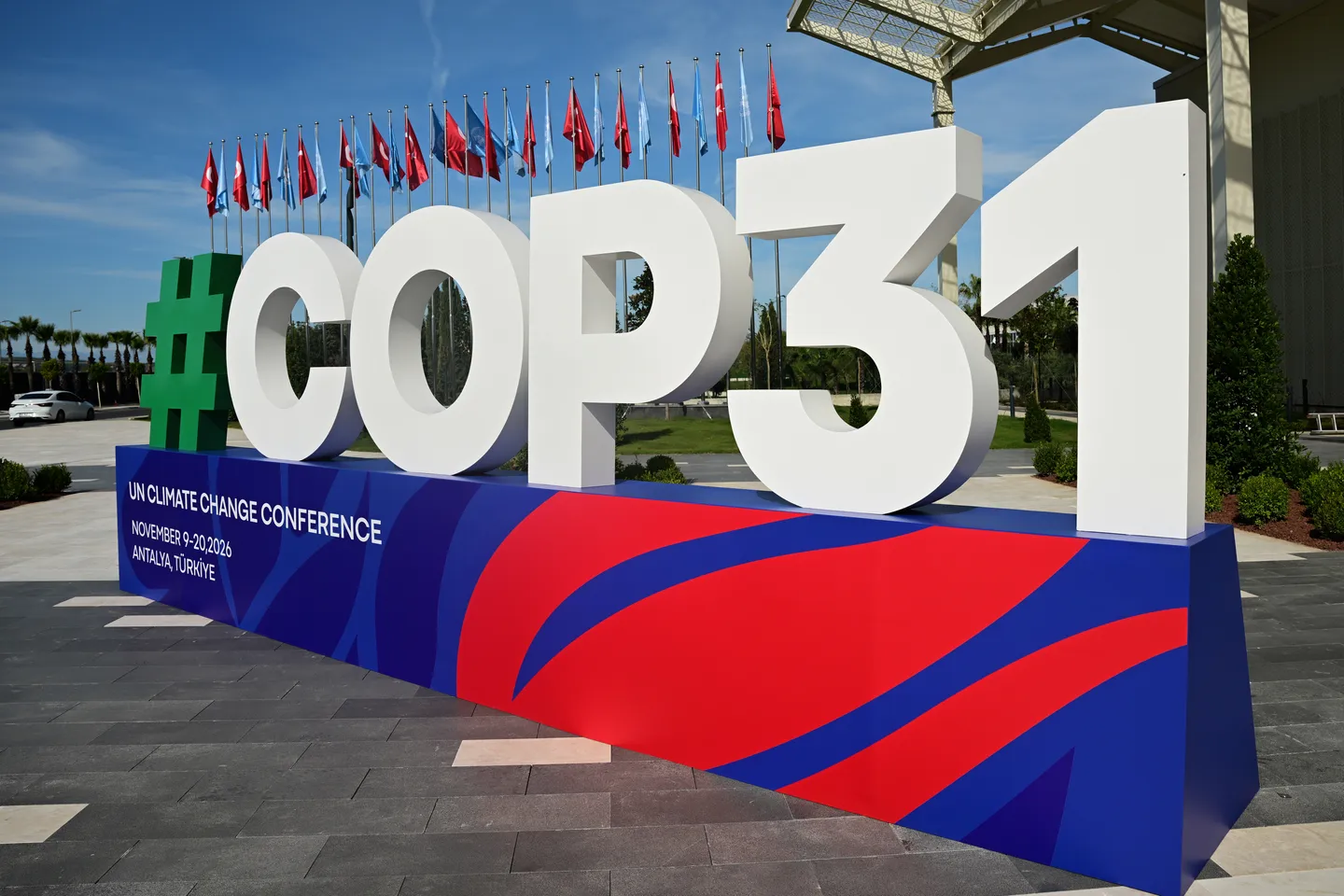
COP31, the 31st UN Climate Change Conference, has brought 68,500 registered participants to Antalya for a summit its hosts have framed around a single idea: implementation.
After three decades in which UN climate conferences have been judged by the targets they set, the test this time is whether existing commitments can be backed by finance, regulation and infrastructure.
The opening day underscored the urgency.
The World Meteorological Organization (WMO) reported that the global average temperature between January and September 2026 was about 1.47°C above pre-industrial levels, while global sea levels had reached a record high.
Nine months with an average temperature near 1.5°C above pre-industrial levels do not mean the Paris Agreement's threshold has been breached, as that limit refers to a long-term average. But they show how little room remains.
What distinguishes Antalya is how the case for action is being made: through legal obligations, public health economics and resource efficiency. Each speaks directly to the ministries that control budgets and legislation, and each points to the same priority: aligning finance and negotiated agreements with the evidence.
Finance divides negotiators
Finance and the energy transition have been central to the talks since the opening session.
When the agenda was adopted, the COP31 presidency proposed addressing the goal of tripling adaptation finance and climate-related trade concerns within existing workstreams rather than as separate agenda items.
The EU supported the approach, while the African Group and the Like-Minded Developing Countries called for greater emphasis on adaptation finance.
Andre Correa do Lago, president of COP30 in Belem, highlighted his presidency's roadmap for transitioning away from fossil fuels, while the Arab Group opposed references to such roadmaps in a COP decision.
Bridging these differences remains one of the summit's central diplomatic challenges.
The legal dimension adds weight to the negotiations.
In July 2025, the International Court of Justice (ICJ) unanimously advised that states' duty under customary international law to prevent significant environmental harm applies to the climate system and requires stringent due diligence. A breach of that duty, the court said, can constitute an internationally wrongful act.
It also said successive national climate plans must demonstrate progression.
Palau's President Surangel Whipps Jr invoked the court's opinion during Wednesday's leaders' segment, attended by Türkiye's President Recep Tayyip Erdogan, UN Secretary-General Antonio Guterres, Brazilian President Luiz Inacio Lula da Silva and Australian Prime Minister Anthony Albanese, among others.
In the negotiations, small island states, the African Group and a Latin American bloc sought formal guidance for the loss-and-damage fund, while the EU, Britain and Canada considered such guidance premature.
How the court's reasoning influences the final agreements remains an important question.
The economic case for climate action
Health economics offers finance ministries a compelling case for action.
A World Health Organization (WHO) analysis released days before the summit estimates that six measures addressing climate crisis and public health could prevent 1.6 million deaths annually.
One measure stands out: efficient fossil fuel pricing could prevent approximately 1.2 million of those deaths and generate about $3 trillion of the estimated $3.9 trillion in annual economic welfare gains.
Fossil fuel pricing would also account for almost all of the 16.7 billion tonnes of carbon dioxide emissions the package could avoid annually, a total equivalent to nearly 30 percent of global greenhouse gas emissions.
The other five measures — heat-health warnings, cleaner household energy, handwashing, safe drinking water and sanitation — would cost approximately $35 billion annually and generate an estimated $24 in benefits for every dollar spent.
Antalya has provided an opportunity to put this evidence into practice.
Türkiye and the WHO launched the Antalya Initiative for Health Resilience, a voluntary platform through which countries can share practical experience and costed approaches to protecting health systems against climate shocks.
Brazil, meanwhile, launched a financing framework for the Belém Health Action Plan, which has 40 signatory countries.
The two initiatives could complement each other, with one facilitating knowledge-sharing and the other mobilising finance.
Both are needed.
As of September 2025, only 56 of the WHO's 194 member states reported having a health adaptation plan under way.
Among developing countries with national adaptation plans, 48 had estimated their combined health adaptation needs at $3.3 billion annually.
Declared international finance for health adaptation in these countries reached $1.1 billion in 2024, approximately a third of the estimated annual requirement.
Cutting waste, reducing emissions
Waste presents another measurable opportunity for climate action.
According to the UN Environment Programme (UNEP), 1.05 billion tonnes of food were wasted in 2022, accounting for 19 percent of all food available to consumers.
Households accounted for 631 million tonnes, food services for 290 million tonnes and retailers for 131 million tonnes.





Household food waste per person differs by only about 7kg annually between high-income and lower-middle-income countries, demonstrating that the problem is not confined to wealthier nations.
It is a shared global challenge involving food storage, cold chains and consumption practices.
Food loss and waste together account for an estimated 8–10 percent of global greenhouse gas emissions, nearly five times aviation's share.
Reducing food waste also offers significant economic and environmental benefits. Better storage, more efficient supply chains and improved waste management can help conserve resources, reduce costs and strengthen food security.
Türkiye has placed waste reduction at the heart of the summit.
On Thursday, Türkiye's First Lady Emine Erdogan and the spouses of visiting leaders inaugurated the Zero Waste Museum at the conference venue.
Nearby, Solak has been developed as a zero-waste village.
International experience offers lessons on scaling up such efforts.
Japan has reduced food waste by 31 percent, supported by a requirement for businesses generating more than 100 tonnes of food waste annually to report their waste. Britain has achieved an 18 percent reduction.
Consistent measurement and reporting offer a practical route to turning local initiatives into national results.
Agriculture and energy show what is possible
Agriculture demonstrates what existing tools can achieve with adequate finance.
CGIAR, a global agricultural research partnership, reports that AgWise, its tool for tailoring fertiliser recommendations to local soil, weather and crop data, has increased yields and profits among Rwandan rice farmers by approximately 60 percent.
The UN's International Fund for Agricultural Development and Türkiye's agriculture ministry launched The Unfunded Half, a report examining the climate finance gap facing women in rural communities.
Then, the Least Developed Countries group proposed a platform connecting countries' adaptation priorities with funders and implementing partners.
Norway, the EU, Britain and Japan questioned how the proposed platform would complement existing institutions.
In the energy sector, implementation is already taking shape.
During the leaders' segment, a group of countries endorsed the COP31 presidency's “35x35” pledge, first announced in June, which aims to increase electricity's share of global final energy consumption from just over a fifth to 35 percent by 2035.
Deployment of clean energy technologies is accelerating.
Installed battery storage capacity in 2025 was 11 times its 2021 level, while the International Energy Agency (IEA) projects that electric vehicles will account for 28 percent of global new-car sales in 2026, compared with less than one percent in 2015.
Investment is also following policy.
The Asian Infrastructure Investment Bank committed $1.6 billion in climate policy financing to Türkiye, supporting reforms in renewable energy, financial regulation and carbon markets.
Can COP31 deliver on finance?
Finance is where the summit's second week could make the greatest progress.
The G77 and China, the largest negotiating bloc representing developing countries, urged negotiators to address the goal of tripling adaptation finance and emphasised developed countries' treaty obligations to provide funding.
The EU, Britain and Norway reaffirmed their support for the goal but proposed addressing it through the existing finance work programme.
The reference point remains the agreement reached at COP29 in Baku: a target of at least $300 billion annually for developing countries by 2035, alongside a broader call to mobilise $1.3 trillion.
Negotiators are also considering how to pay for the infrastructure needed for carbon trading under Article 6 of the Paris Agreement.
The African Group favours core funding, while the EU prefers a system financed through user fees.
Leaders' speeches reflected the breadth of national priorities.
Island states called for rapid emissions reductions, developing countries pressed for finance, and European leaders emphasised electrification, also a priority for Türkiye’s COP31 presidency.
Climate Action Tracker estimates that current policies would put the world on course for 2.7°C of warming by 2100. If countries met all their 2030 and 2035 targets, projected warming would fall to 2.6°C.
The small difference shows why governments need to deliver on existing commitments and set more ambitious targets.
The ICJ has clarified states' legal obligations, the WHO has estimated the health gains from climate action, and UNEP has measured the scale of food waste. In agriculture and energy, proven tools and technologies are already delivering results.
At COP31, negotiators can act on this evidence by reaching agreement on adaptation finance, providing guidance for the loss-and-damage fund and taking concrete steps to advance the energy transition.
If negotiators can deliver on those priorities, Antalya could mark a turning point in translating climate commitments into action.