A powerful Hindu extremist group, whose member assassinated Mahatma Gandhi, revered in India as the Father of the Nation, which was banned thrice and from which Indian Prime Minister Narendra Modi's party emerged has said it had organised foreign trips, including to the US, to counter perceptions it is a paramilitary outfit involved in large-scale attacks on minority communities.
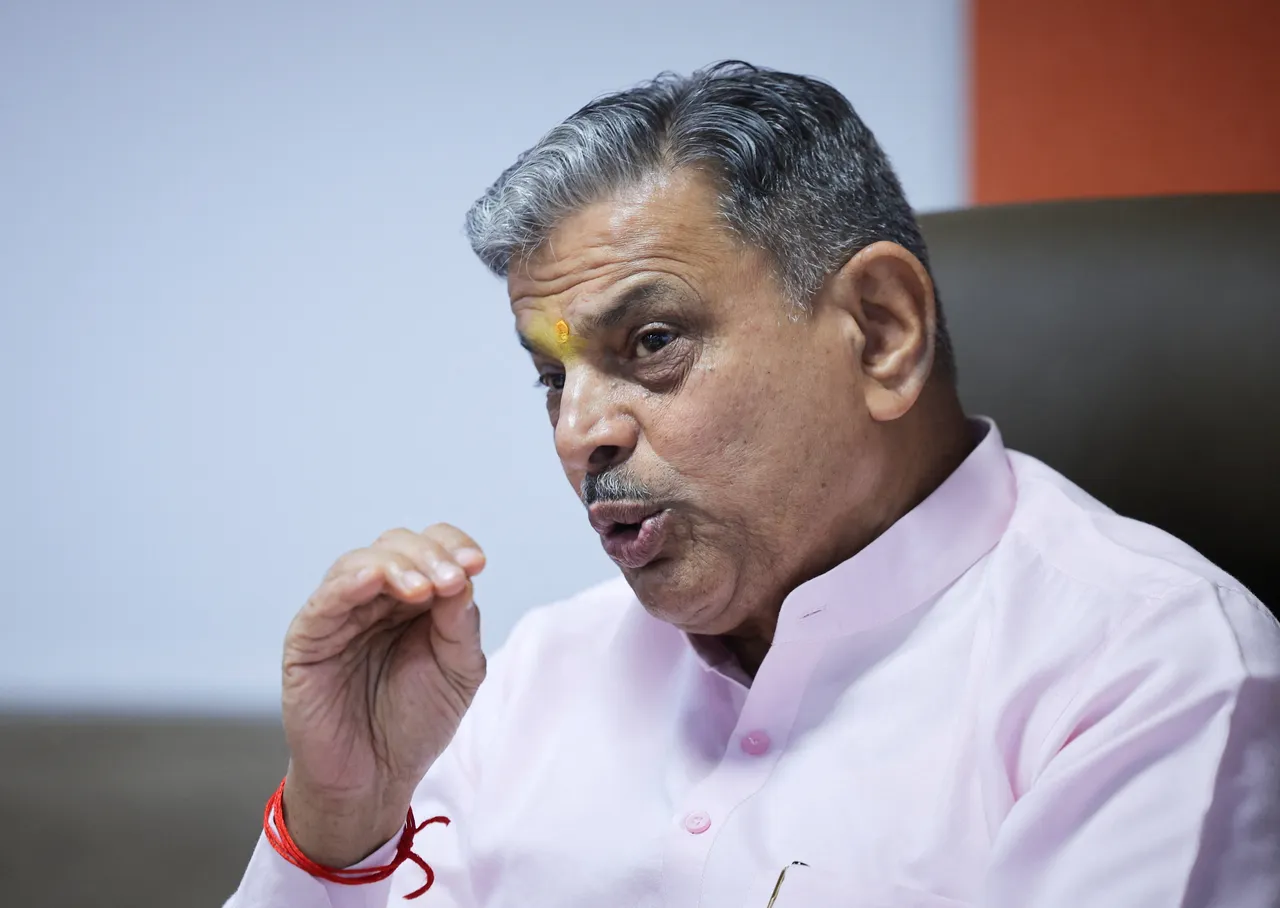
The Rashtriya Swayamsevak Sangh (RSS) general secretary Dattatreya Hosabale said on Tuesday that he has been addressing gatherings in the US, Germany and Britain, with more planned, to "dispel certain misgivings and misconceptions about the RSS".
He said the main accusations against the supremacist group, also world’s largest paramilitary organisation, included that it was "pulling society backwards", that it promotes "Hindu supremacist things", and that "others have become second-class citizens".
"The fact is entirely different," Hosabale told a rare briefing for foreign media in the group's newly built 12-floor building in Delhi.
Hosabale said he met academics, policymakers and business leaders in his visits.
He said RSS leaders would visit more countries in Europe, Southeast Asia and other regions to raise awareness about the organisation.
The outreach by the supremacist group came after the US Commission on International Religious Freedom (USCIRF) said in a report in November that it "has been involved in acts of extreme violence and intolerance against members of minority groups for decades".
The commission is a bipartisan body of the US federal government that monitors religious freedom around the world and makes policy recommendations to the president, the secretary of state and the US Congress.
Global Magnitsky sanctions
Last week, an expert tracking Hindu hate crimes against Muslims and Christians and other marginalised groups in India testified before USCIRF, telling it the persecution "bears the sanction of the country's top political leadership led by Prime Minister Narendra Modi" and is carried out through the state apparatus and the militant networks of RSS and its affiliates, including the Bajrang Dal and Vishwa Hindu Parishad.
Raqib Hameed Naik, the Executive Director of the Center for the Study of Organized Hate (CSOH), presented a record of human rights abuses against minorities in India and called for targeted Global Magnitsky sanctions against leaders of Modi’s Bharatiya Janata Party (BJP), RSS and others.
Modi joined the RSS in his youth, and the rise of his BJP to near-national dominance is widely attributed to the RSS' vast network of cadres, during a period marked by a hardening Hindu-Muslim political divide in the officially secular country where Hindus (over 80 percent and over a billion) are a majority.
The RSS claims it is a "Hindu centric civilisational, cultural movement" whose goal is to "carry the nation to the pinnacle of glory", including by uniting Hindus and protecting the religion.
It has been banned several times since its inception in 1925, including after a member Nathuram Godse assassinated independence hero Gandhi in 1948.
Indian opposition leaders, particularly Rahul Gandhi of the main opposition Congress party, have repeatedly accused the RSS of promoting a divisive, majoritarian ideology that he says threatens India’s secular fabric and fuels intolerance towards minorities.
Modi has already delivered on two key agenda items for the RSS: building a temple to the Hindu deity Ram on the site of a some 400-year-old mosque razed by Hindu zealots in 1992, and annexing the Muslim-majority India-administered Kashmir in 2019.
The other key goal is to end discrimination based on Hindu caste, Hosabale added.
India's opposition successfully leveraged concerns among underprivileged castes to hand PM Modi a rare setback in the 2024 national election, when his party fell short of a majority and was forced to rely on allies.

Hudson Institute hosts RSS big-wig
Hosabale, who was in Washington DC recently for a talk at the conservative think-tank the Hudson Institute, said that "Hindus have never followed supremacist ideas, never invaded any country and have nothing to apologise for."
Hosabale echoed comments made by Indian Defence Minister Rajnath Singh, who has frequently stated that India has never invaded or occupied any country or region.
Historians, however, say Hindu rulers and empires have invaded and conquered other countries and kingdoms multiple times in history.
After gaining independence from Britain in 1947, Indian troops entered Goa and annexed the region which was under Portuguese rule for over 450 years.





Lisbon described it as an "invasion of Goa".
Indian troops entered the princely states of Kashmir, Hyderabad and Junagadh, which were de facto independent in 1947 and 1948, and annexed them. Pakistan and China also administer portions of the Kashmir region. RSS cadres are said to have played a huge role in widespread massacres of over 230,000 Muslims in southern portions of Kashmir.
In 1971, India launched a multi-pronged invasion into then East Pakistan, a sovereign Pakistani territory, which led to the creation of Bangladesh.
Comparisons with Ku Klux Klan
Hosabale noted that "misconceptions" persist in the US regarding India, often reduced to stereotypes of poverty and 'snakes and swamis', adding his RSS is not "some Indian version of the Ku Klux Klan."
Ku Klux Klan (or KKK), is a notorious US white supremacist group, established in 1865, and known for using terrorist tactics — violence, intimidation, and murder — to enforce racial hierarchy and oppose civil rights in America.
The RSS does not operate directly in the US as an official entity. But its activities and ideology are carried forward primarily through the Hindu Swayamsevak Sangh USA (HSS USA), widely described as its international or overseas wing and affiliate, by activists and scholars.
HSS runs some 267 shakhas (branches) across 33 American states.
HSS acknowledges ideological inspiration from the RSS and a broader lineage of Hindu revival movements in India, on its website.
"HSS USA is also inspired by a long lineage of Hindu movements in India, including the Rashtriya Swayamsevak Sangh (RSS), which have helped rejuvenate the society and take Hindu civilisation forward," it says.
These scholars, activists, and reports — for example from Georgetown’s Bridge Initiative, Rutgers Center — argue that HSS functions as the de facto US arm of the RSS, helping spread Hindu nationalist ideas, raise funds for India-based projects, and build diaspora political influence.
HSS and supporters reject these characterisations as biased or politically motivated attacks on Hindu cultural organising.
The RSS recently sparked controversy in India after reports emerged that it hired a top US lobbying firm, which was also linked to Pakistan, India’s nuclear-armed arch-rival.
Official filings and lobbying disclosure documents showed that RSS made a payment records of $330,000 to Squire Patton Boggs to lobby officials in the US Senate and House of Representatives on behalf of the RSS.