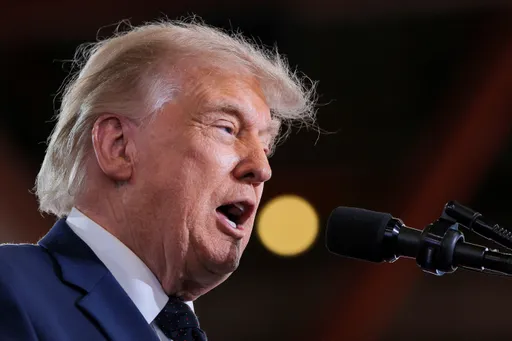
President Donald Trump has said that he will hike US tariffs on cars and trucks from the European Union next week, charging that the bloc is not complying with an earlier trade deal.
"Based on the fact the European Union is not complying with our fully agreed to Trade Deal, next week I will be increasing Tariffs charged to the European Union for Cars and Trucks coming into the United States," Trump said on Friday.
"The Tariff will be increased to 25 percent," he wrote on his Truth Social platform.
The pact, which was struck last summer, had capped the US tariff on EU autos and parts at 15 percent, which is lower than the 25-percent duty that the Trump administration imposed on many other trading partners.
These sector-specific duties were not affected by a Supreme Court ruling earlier in the year that struck down a swath of Trump's global levies.
Reacting to the announcement, a European Commission spokesperson told AFP news agency: "Should the US take measures inconsistent with the joint statement, we will keep our options open to protect EU interests."
The spokesperson added that the bloc is implementing its commitments "in line with standard legislative practice" and keeping the Trump administration updated during this process.
"President Trump's behavior is unacceptable," Bernd Lange, the chair of the European Parliament's international trade committee, told Reuters news agency after the surprise tariff post.
"This latest move demonstrates just how unreliable the US side is. We have already witnessed these arbitrary attacks from the US in the case of Greenland; this is no way to treat close partners. Now we can only respond with the utmost clarity and firmness, drawing on the strength of our position," Lange said.
"The German government and the European Commission must now finally show some backbone and stand up to Trump. Only that can prevent a continuing escalation," said Marcel Fratzscher, president of the DIW economic institute, calling for retaliatory tariffs and taxation of US tech companies.
Last July, the EU had laid the groundwork for possible retaliation if talks with Washington fell through — preparing a list of US goods that could be targeted.
Conditional approval





In late March, EU lawmakers gave their green light to the bloc's tariff deal with US, but with conditions.
A large majority of EU lawmakers agreed to cut EU tariffs on some US imports, as a first step towards implementing the 2025 deal, but they also sought additional safeguards.
Although the European Parliament has given its conditional approval to the EU-US trade pact, before the deal is implemented by the bloc, it still needs to be negotiated with EU states.
The new threat on European cars "explain why many small businesses expect to be cautious" with US tariffs, said Dan Anthony, who heads "We Pay the Tariffs," a coalition of nearly 1,200 small businesses.
"You never know what might trigger the next tariff threat," Anthony added in a statement.
Trump's latest announcement also came a day after his renewed criticism of German Chancellor Friedrich Merz. Trump told Merz to focus on ending the Ukraine war instead of "interfering" on Iran.
Germany would likely be hit hard by a sharp tariff on cars and parts, as it is responsible for a significant amount of EU auto exports.
In April, EU trade chief Maros Sefcovic was in Washington to meet with counterparts including US Commerce Secretary Howard Lutnick and trade envoy Jamieson Greer.
At the time, he said that the EU was also seeking more progress in easing the effects of still-steep US steel tariffs, adding that talks were going in a positive direction.
The United States is the second largest market for new EU vehicle exports, after the United Kingdom, according to a 2025 fact sheet by the European Automobile Manufacturers' Association.
Over a fifth of EU vehicle exports went to the United States.
Germany alone exported some 450,000 vehicles to the United States in 2024, according to the VDA industry group. But that figure has since slipped.