 Murat Sofuoglu
Since October 7, 2023, Israel's genocidal war on Gaza has resulted in more than 240,000 Palestinian casualties, including nearly 75,000 deaths, while displacing hundreds of thousands of people from their homes across the besieged enclave.
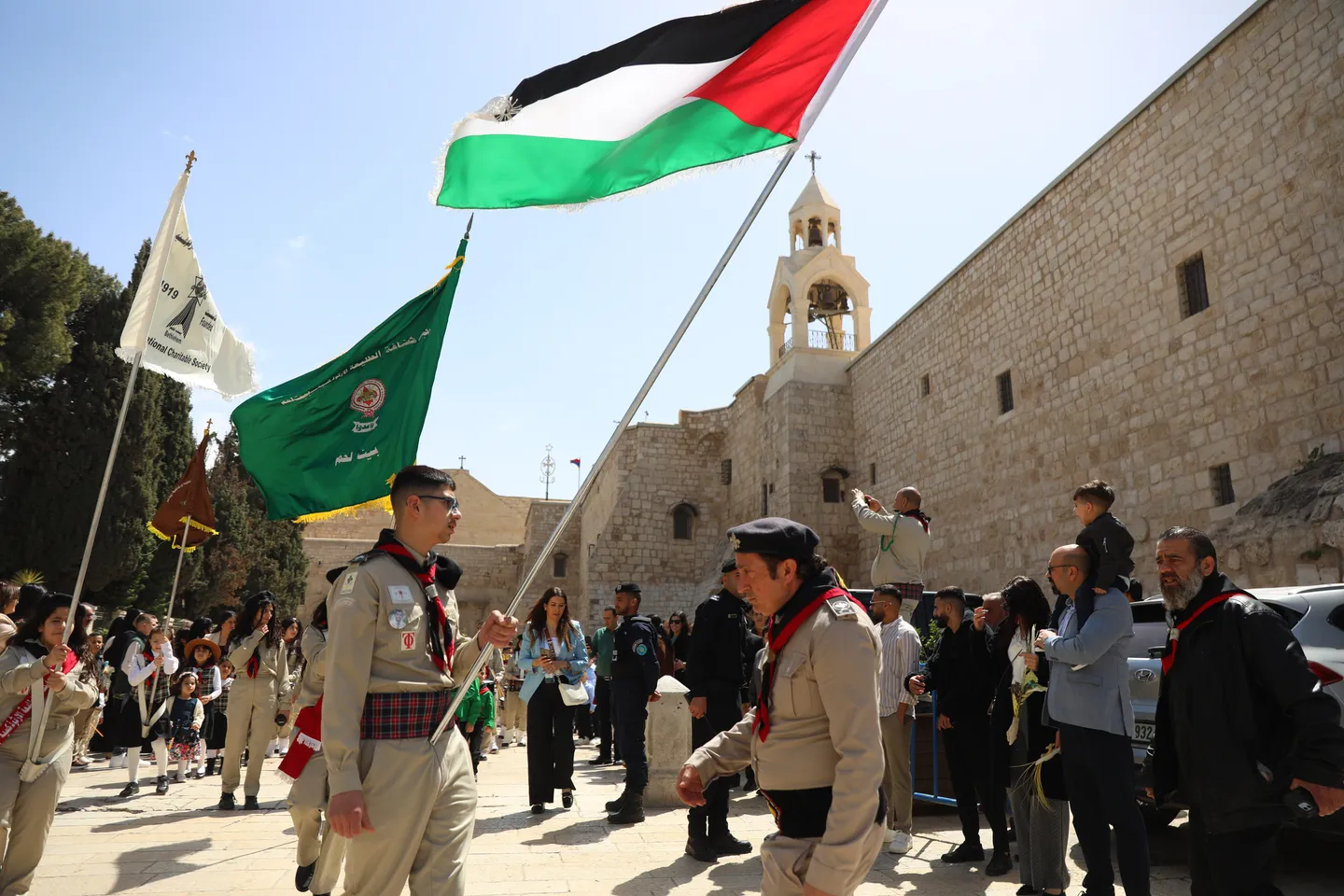
Beyond Gaza, Palestinian Christians say they have faced a sharp rise in violence across the occupied West Bank and East Jerusalem.
Church leaders and analysts point to an increase in settler attacks on Christian communities, including the burning of Christian-populated villages that have forced residents to flee, alongside a growing pattern of harassment targeting clergy, from Jewish extremists spitting at priests and nuns in occupied East Jerusalem to physical assaults, vandalism and intimidation.
“Increased settler attacks on Christians, both in Jerusalem (al-Quds) and the West Bank, are an expression of Israeli ethno-nationalism and an ideology of Jewish supremacy. Their concept of nationalism excludes all who do not fit their definition of who belongs in a state they imagine as theirs alone,” Robert O Smith, an associate professor of Authentic Diversity, Justice, and Public Church at the Lutheran School of Theology, tells TRT World.
“Settlers are increasingly empowered. They have long employed thuggery to achieve their aims. These attacks—both individual spitting attacks and assaults—and terrorist attacks on villages are extensions of longstanding patterns,” Smith says.
Israeli Prime Minister Benjamin Netanyahu's dependence on far-right coalition partners has left him unwilling to challenge settler groups accused of attacks on Palestinian Christians, according to Smith.
The issue has also drawn growing attention in the United States. In recent months, outlets including The Wall Street Journal and CNN have reported on harassment and violence directed at Christian communities in occupied East Jerusalem and the occupied West Bank.
Long before those reports, however, images circulating on social media had already sparked outrage. Videos of Jewish extremists assaulting Christian clergy in occupied East Jerusalem, alongside footage of an Israeli soldier vandalising a statue of Jesus Christ on the cross in the southern Lebanese border village of Debel, have drawn condemnation from prominent American commentators and politicians, particularly within Christian circles.
Commentator Tucker Carlson and former Republican congresswoman Marjorie Taylor Greene have both questioned Washington's continued support for the Netanyahu government, arguing that Palestinian Christians, alongside Muslims, have also come under attack.
Whether those criticisms signal a broader shift within the traditionally pro-Israel Evangelical movement, however, remains an open question.
Motti Inbari, a professor of Jewish Studies at the University of North Carolina at Pembroke, believes the growing visibility of attacks on Christians could begin to influence parts of the American Christian public that have long supported Israel.
“It's all accumulating. I don't think that one thing creates a change, but it's accumulating, and it may result in some change in public opinion over time, and it started to be noticed that some Israelis are treating Christians in a way that is unacceptable,” Inbari, who has studied Christian Zionism, tells TRT World.
“It may cause Israel a lot of damage, absolutely,” he adds.
Inbari argues that extremist Israeli National Security Minister Itamar Ben-Gvir has a political incentive to fuel tensions in the occupied West Bank, hoping Palestinian retaliation to settler attacks will strengthen support for his hardline agenda.
"That's the strategy of Ben-Gvir," he says. "He's living from violence."
But because Ben-Gvir serves in Netanyahu's governing coalition, Inbari says ultimate responsibility for failing to curb settler violence lies with the Israeli prime minister.
"Netanyahu sees the violence on the street. Netanyahu sees the violence everywhere, and he's not firing him and he's not doing anything about it," Inbari says.
"He's letting it happen because Netanyahu benefits from it as well."
According to Inbari, Netanyahu's reliance on far-right coalition partners risks damaging Israel's standing among American Christians as attacks on Palestinian Christians receive greater international attention.
Evangelical youth turns against Israel
Recent polling also suggests support for Israel among American Evangelicals has softened, particularly among younger generations, challenging the long-held assumption that Christian Zionists remain uniformly pro-Israel.
Although Evangelicals have traditionally been among Israel's strongest supporters—many believing the Jewish people have a biblical claim to the Holy Land based on their interpretation of scripture—Inbari says that consensus has begun to erode, particularly since October 7, 2023.





A University of Maryland survey published last year found that sympathy for Israel had fallen to 51 percent among older Evangelicals, while support among younger Evangelicals stood at just 24 percent, pointing to a growing generational divide.
“We see the same results, and we've seen them for a long time, that the younger generation in the evangelical community is much less supportive of Israel than their parents and especially their grandparents. There is a big generational divide,” Inbari observes.
“I can tell you that this generational divide is true for all Americans, not just evangelicals. Older Americans tend to be more supportive of Israel than the younger Americans. It's true across the board. But it's very clear in the evangelical community too.”

Inbari attributes the shift to growing political and generational divisions within the American evangelical community, which he describes as one of the country's most polarised religious groups.
According to him, younger evangelicals have become more sympathetic to Palestinians than older generations, reflecting a broader ideological divide that extends beyond Israel.
"The evangelical community is going through a generational dispute," he says, arguing that younger evangelicals tend to hold more centrist political views, while older generations remain more conservative and firmly supportive of Israel.
Will Puritan America go against Israel?
The historical roots of that support run deep.
Many scholars trace American Christian Zionism to the influence of the 17th-century Puritans, whose reading of the Old Testament emphasised the biblical covenant between God and the Jewish people.
That theological tradition, combined with the influence of pro-Israel lobbying groups, has helped make Evangelicals one of Israel's most reliable constituencies in the United States, according to experts.
Despite those longstanding ties, some analysts believe growing concern over violence against Palestinian Christians is beginning to complicate that relationship.
Gokhan Batu, an expert on Israeli society and politics, says attacks on Palestinian Christians have made support for Netanyahu's government a more difficult issue for some Christian Zionists.
"For many Christian Zionists, support for Israel is rooted in a theological worldview often expressed through the belief that 'God blesses those who bless Israel.' Their faith is therefore tied to the very existence of Israel, making this relationship much harder to shake than conventional political support," Batu tells TRT World.
Batu says criticism of Netanyahu has become more pronounced even among traditionally pro-Israel Evangelicals.
"Israel's treatment of Palestinian Christians directly challenges the image of Israel that they have long defended. I would therefore say that it is already affecting support for Netanyahu personally."
Whether that translates into a broader shift away from Israel, however, is far less certain.
"Whether it can weaken their broader support for Israel is a different and much deeper question that requires a serious theo-political analysis," Batu says. He argues that Israel recognises the strategic importance of its Evangelical constituency in the United States and has made "a concerted effort not to lose it."
"This leaves us with a difficult question: if everything that has happened so far has still not produced a decisive break, what would?" he asks.
Smith draws a similar distinction between support for Netanyahu and support for Israel itself.
"Christian Zionist support for the State of Israel is based on wildly diverging interests. For the most part, Christian Zionists aren't all that concerned with day-to-day life in the land. They see it as an apocalyptic playground. So they won't notice most of these developments," he says.
Smith argues that attacks on Palestinian Christians are unlikely, on their own, to fundamentally reshape those beliefs.
"Christian Zionists have long dismissed the perspectives of Palestinian Christian communities and those who would sympathise with them. They may be initially offended by video footage, but their concern has never been primarily with the Indigenous Christian communities of the land."