 Yusuf Kamadan
For generations, the high peaks and hidden valleys surrounding the historic city of Amasya in northern Türkiye have played host to an obsessive, quiet hunt. Academics, seasoned botanists, and foreign plant hunters have spent more than a century scouring the rugged terrain for Tulipa sprengeri, or the ‘Lost Turkish Tulip’ — a plant so rare that its documented existence in the wild abruptly ceased in 1896.
The search for the tulip came to an end earlier this year.
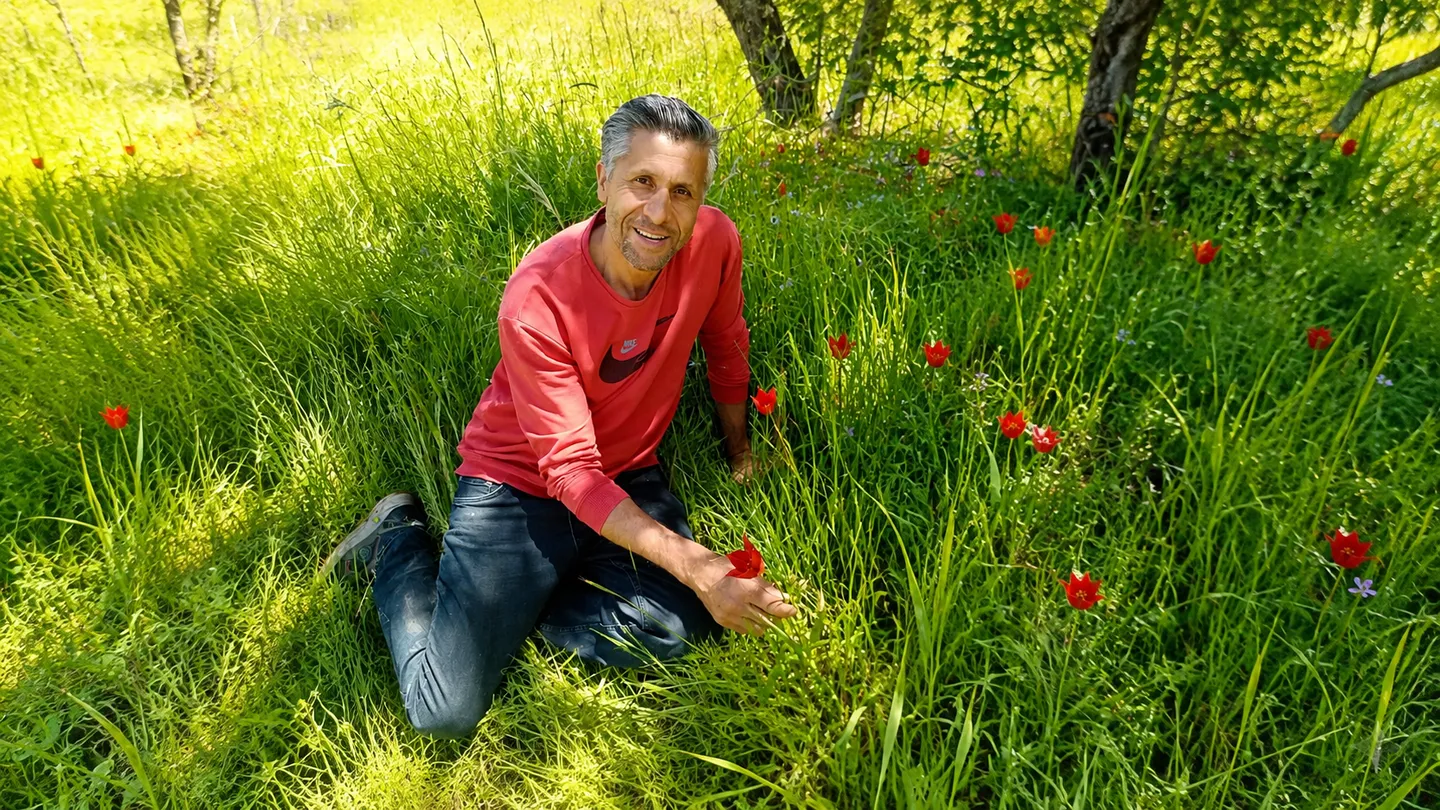
But the definitive breakthrough did not come from a university expedition or a heavily funded scientific project. Instead, history was made by Ercan Eftelioglu, a now-retired building janitor, who spends his weekends walking through the wilderness. By keeping his eyes closer to the soil than the rest of his hiking group, Eftelioglu achieved what the international botanical community had deemed impossible: he found the lost icon of Ottoman flora.
A lifelong bond with the soil
To understand how Ercan Eftelioglu succeeded where so many experts failed, one must look to his roots. Born in 1974 in the rural heartlands of Amasya, his deep relationship with the natural world began in early childhood.
"Because I was born and raised in the countryside, I’ve held a distinct, deeply rooted interest in nature and plants since I was a young boy," Eftelioglu tells TRT World. "More than that, our father was a forest ranger. In our family, a profound love for nature is something inherited; it is passed down through the generations."
From early on, Eftelioglu felt a unique attraction towards the tulip, a flower that carries profound historical, cultural, and spiritual weight in Türkiye, and particularly in Amasya.
"It is a plant intricately intertwined with the identity of Amasya. In traditional iconography, it symbolises the unity of the Divine, and it stands as the ultimate emblem of the Ottoman Empire,” he explains.
“Because a fully bloomed tulip closely resembles the Arabic script for the word 'Allah', it captured the imaginations of the Ottoman princes, the shehzades, who lived and ruled here in Amasya. It became the signature of the Ottoman banner, an omnipresent motif in mosque calligraphy, and a staple of traditional carpet weaving."
The moment of discovery
It was Eftelioglu’s weekly hikes with a local trekking group, Akdost, exploring Amasya’s vast, mountainous terrain that led to the discovery on June 7 2026. While others walk for exercise or companionship, his focus always remained firmly on the ground beneath his boots.
"I am always closely observing the environment, collecting various medicinal herbs and wild flowers," Eftelioglu recalls. "On that particular day, as I was scanning the surroundings, an unusual tulip species caught my eye. The trekking group I was with was quite large, and practically everyone walked right past the exact same spot. But because they didn't know the history, they just took a few casual photos, assumed it was a common, ordinary wildflower, and kept moving along the trail."
Eftelioglu stayed put. His mind immediately connected the flower in front of him to something he remembered from the past.
"I knew the context," he says. "Years ago, someone had introduced me to the specific characteristics of this plant, and it immediately struck me that this specimen looked remarkably like the legendary Lost Tulip of Amasya.”
Eftelioglu and his brother had, in fact, spent years searching Amasya for the tulip, even collecting a few promising samples and sending them to authorities. But, he says, the official response was always the same: “the species was extinct, its lineage entirely wiped out in the wild."
Refusing to let the moment slip away, Eftelioglu took detailed photographs of the bloom and resolved to bypass the standard bureaucratic channels, reaching out directly to frontline experts.
From the mountainside to the laboratory
Eftelioglu’s photographs set off an immediate chain reaction within the upper echelons of Turkish botany. He sent the images to Salih Sercan Kanoglu, the Director of the Nezahat Gokyigit Botanical Garden in Istanbul. Recognising the immense potential of the find, Kanoglu wasted no time, instantly contacting Professor Ismail Eker from the Department of Biology at Bolu Abant Izzet Baysal University.








Clearing their schedules, the two experts travelled to Amasya, met with Eftelioglu, and trekked out to the secret location where the Lost Tulip was clinging to life. The physical examination confirmed what the historical record had long denied: Tulipa sprengeri was alive.
The historical irony of the discovery is not lost on Eftelioglu. "This specific tulip variant was carried away from its native soil centuries ago by European diplomats and plant collectors," he notes. "For the longest time, the very last known living examples of this species were thought to exist exclusively within the private gardens of the British Royal Family. To find it thriving here, back where its journey began, is nothing short of a miracle."
The fragility of a botanical miracle
While the scientific community celebrates, Eftelioglu is under no illusions about the precarious state of the discovery. The location of the site is currently being kept a closely guarded secret, and authorities have moved quickly to place the area under strict environmental protection.
"Nature possesses a magnificent way of offering immense surprises to humanity, even during our most despairing moments," Eftelioglu muses. "The resurrection of the Lost Tulip is perhaps the most tangible and exhilarating proof of this. It lay hidden in a forgotten corner of the wilderness, waiting to bloom again. But while this unexpected discovery has sent a wave of joy through the botanical world, it also places a massive, undeniable weight of responsibility onto the shoulders of nature lovers like us."
He warns that the thrill of the find must not mutate into complacency. The survival of Tulipa sprengeri remains on a knife-edge.
"The rediscovery of the Lost Tulip is undoubtedly a historic turning point for biodiversity conservation," Eftelioglu stresses.
"However, the fact that we found it does not mean the danger has passed. On the contrary, it highlights just how fragile and delicately balanced the species' existence truly is. Surviving in a highly restricted geographical pocket, under incredibly specific climatic and topographical conditions, this plant remains completely defenceless against human encroachment and the accelerating climate crisis."
A blueprint for survival
To ensure that the Lost Tulip does not vanish for a second, permanent time, Eftelioglu is advocating for a rigorous, multi-tiered framework of protection that bridges grassroots vigilance with institutional science.
"The specific zone where the tulip was discovered must be declared an immediate, inviolable sanctuary," Eftelioglu asserts. "The area must be legally and permanently closed off to all forms of land development, agricultural grazing, and mining activities."
Due to his passion for nature, Eftelioglu is also familiar with scientific approaches that he believes should be used to preserve the tulip.
"The population dynamics of this colony must be meticulously monitored by specialist botanists. Furthermore, its seeds must be harvested and secured in both national and international gene banks as an insurance policy against a localised ecological catastrophe " he says.
"Under no circumstances should this discovery site be transformed into a commercial tourism destination. The sheer weight of heavy foot traffic would lead to soil compaction, destroying the delicate ecology and crushing the underground tulip bulbs."
For the janitor who stepped into the pages of botanical history, the lesson of Tulipa sprengeri extends far beyond a single flower. It is a mandate for how humanity interacts with the wild.
"A true nature lover is not someone who merely stands back and passively spectates," Eftelioglu says. "A real conservationist is someone who actively defends the rights of the earth and fights to protect it. In safeguarding rare, priceless species like the Lost Tulip, every single one of us has a vital, non-negotiable duty to fulfil,” he says.
Summing up, he says: “We must take nothing from nature but photographs, and leave nothing behind but our footprints.”