A severe heatwave sweeping across Europe is being linked to a rising death toll, with Spain estimating 212 heat-related deaths in just four days and multiple fatalities reported in France.
As temperatures shatter records from the Iberian Peninsula to Britain, authorities are warning that extreme heat is becoming an increasingly deadly public health threat.
Here’s the latest.
Netherlands
The Netherlands issued its first-ever red alert for heat for Friday, warning of "dangerous" conditions as a record-setting heatwave scorched Europe.
The national weather institute issued the alert for much of the country, where temperatures are forecast to reach 40°C in some places.
Switzerland
Switzerland registered its hottest-ever June temperature on Thursday, with 38°C measured in the northern city of Basel, breaking a previous record of 36.9°C set eight decades ago, the Swiss weather service said.
"Temperatures exceeded 37°C for the first time in Switzerland during June, breaking a record set in 1947," MeteoSuisse said on X.
It highlighted that "a temperature of 38°C was even recorded at the Basel weather station", the same place where the 1947 record was logged.
Heatwave linked to 212 deaths in Spain Sunday-Wednesday
A record heatwave that has gripped much of Europe could be linked to 212 deaths in Spain between Sunday and Wednesday, according to estimates from a public institute.
The MoMo monitoring system compiles daily death statistics in Spain and compares them with the levels forecast based on historical records.
It also incorporates external factors, such as weather data from the national weather agency AEMET, to assess likely causes of mortality spikes.
Its data registered an excess mortality of 98 deaths for the same four days of 2025, during what was the hottest summer on record in a country on the front line of climate change.
The number of heat-related deaths in Spain between May 16 and September 30 last year hit 3,832, an 87.6-percent increase from the same period in 2024, according to MoMo data.
Mainland Spain this week recorded its highest daily average temperatures in June since at least 1950, with Monday's figure of 28.08°C followed by 28.17°C on Tuesday.
Those two days also marked the highest average minimum temperatures for June since 1950, with 20.14°C recorded on Monday and 19.81°C on Tuesday. These so-called "tropical nights" make sleep challenging and can threaten public health.
The weather sparked the highest alert in parts of northern Spain, including Cantabria and the Basque Country, which are usually spared the harshest heat but where temperatures soared past 40°C.
Most weather alerts had been lifted on Thursday, with the lowest yellow level in force in the north.
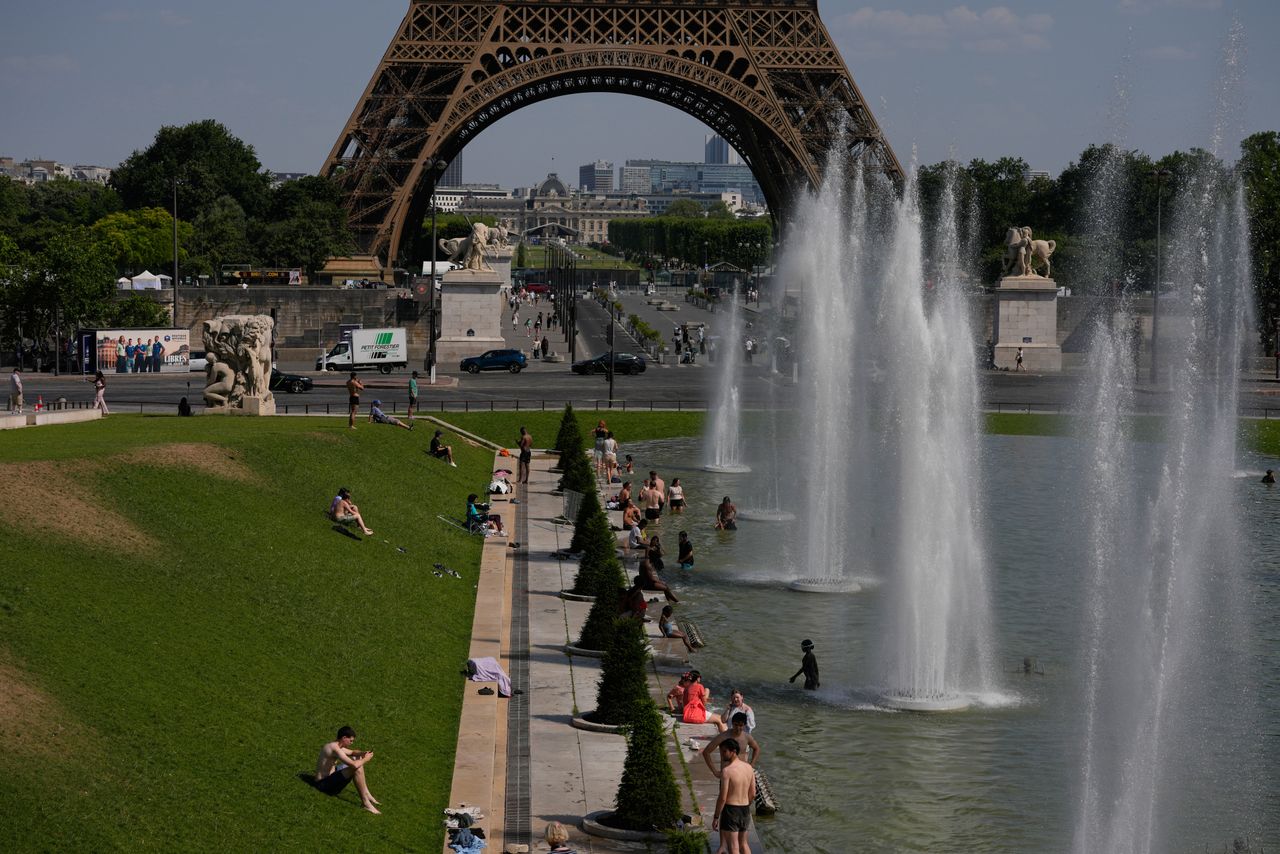
Multiple deaths, over 25 cardiac arrests reported across France
Meanwhile, multiple deaths were also reported in France on Thursday.
French broadcaster BFMTV, citing police sources, said two people died on Wednesday, likely due to the high temperatures.
A 69-year-old man suffered a medical emergency on a street in Angers, in the Maine-et-Loire department, and died while being transported to a hospital. A 91-year-old woman also died at her home in the commune of L'Hopital in the Moselle department, according to the broadcaster.
In the Pas-de-Calais department, the prefecture said late on Wednesday that three people died at home in cases in which the heatwave may have been a contributing factor.
Authorities said the victims included a man carrying out outdoor work and two people with underlying medical conditions.
Separately, Jean-Francois Cibien, vice president of Samu-Urgence de France, an association representing France's emergency medical services, told BFMTV that a patient died in a hospital room, reportedly because of the heat, but did not specify the location.
"There is something happening in terms of mortality," Cibien said.
"For the first time, we are seeing deaths occurring in hospital rooms because of extreme temperatures," he added.
BFMTV also reported, citing local sources, that emergency responders treated more than 25 cardiac arrests across the inner suburbs of Paris overnight, compared with a usual average of fewer than five cases per night.

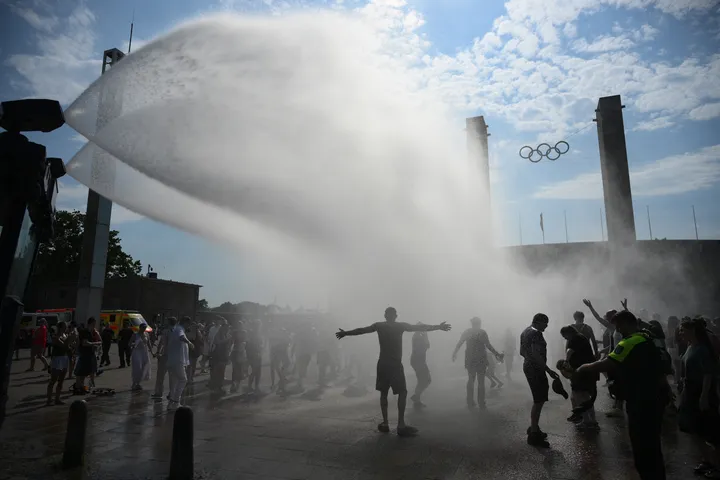






France on Wednesday recorded the hottest day since measurements began in 1947, the national average temperature reaching 30°C.
Paris mayor Emmanuel Gregoire earlier on Thursday reported that deaths were on the rise in the capital, but did not give a specific figure.

Three-year-old found dead in car
A three-year-old was found dead in a car in the Paris region, a police source said on Thursday, the third such fatality of a child during the extreme weather this week.
Parents found the boy in "the car outside their home", the source said. Civil defence confirmed his death in the town of Saint-Gratien in the Paris suburbs.
Temperatures in the capital reached 40.3°C on Wednesday, topping 40°C for the fourth time in 150 years.
Two children were found dead in a car in southern France on Monday.
The two victims, aged two and four, were found dead in their family's car in a residential parking lot in the town of Carpentras.
Heatwave-hit London climate week spurs calls for faster action
London, too, got a glimpse of the future normal during its eighth annual climate week after an event dedicated to discussing the impacts of extreme heat at the London School of Economics was cancelled because the venue was too hot.
The event was due to have been held in a near-100-year-old building that, like many in Britain, relies on natural ventilation and fans to cool visitors rather than air conditioning. The organisers said they called it off due to a risk to public health.
For Chris Anderson, a climate expert at non-profit Practical Action, the cancellation, as British temperatures hit a provisional record June high, was a stark reminder that the dangers of a warming planet would impact everyone.
"There's a real irony that an event designed to help vulnerable people adapt to extreme heat in a temperate, wealthy country had to be cancelled," Anderson said.
The UK recorded its hottest ever June day on Thursday, with temperatures reaching 36.4 °C in southwestern Somerset, breaking the previous day's record as the extreme heat stretched London's ambulance services.
The Met Office weather service said the record-breaking June temperature had been clocked in the Somerset village of Yeovilton, after Wednesday's high of 36.1°C was registered further east in Gosport, Hampshire.
Temperatures set to surpass 35°C on Thursday for over 100 million in Europe
At least 101 million people in Europe are expected to experience temperatures in excess of 35°C on Thursday, including 50 million in France and 18 million in Germany, according to AFP calculations.
Maximum temperatures are expected to surpass 30°C for more than 380 million people across Europe excluding Türkiye, representing nearly two-thirds of the population, according to an analysis based on forecasts from the German weather service and 2025 population projections from the Joint Research Centre.

The figures broadly align with projections by the Austrian NGO Klimadashboard, and are up from Wednesday, when the German weather service said 94 million people were impacted by temperatures exceeding 35°C.
Mainland France was again the most impacted, where around 63 million people will see temperatures of more than 30°C.
The heat will also surpass 30°C for 70 million people in Germany, 48 million in Italy and 38 million in Britain.
Belgium, Luxembourg and the Netherlands will also be impacted by the heatwave searing much of Western Europe since last weekend, as will people in Poland, Hungary, the Czech Republic and Croatia.
Extreme heat warning
At the London xlimate week, Helen Clarkson, CEO of Climate Group, said the heatwave showed "science has come to life, and reality is clearly showing there is more of this to come."
UN Secretary-General Antonio Guterres called for capital markets to see building this resilience as an asset and for governments to do more to fund projects, including taxing the windfall profits of fossil fuel producers.
The calls to move faster come as global heat-related deaths have risen 23 percent since the 1990s to an average 546,000 deaths a year, many of them in developing countries, an October Lancet report said.
The UK's Climate Change Committee, an independent body advising the government, has called preparations "inadequate" and estimates that investment of around £11 billion ($14.5 billion a year is needed to fix that.
It has warned that heat-related deaths could exceed 10,000 a year by 2050.