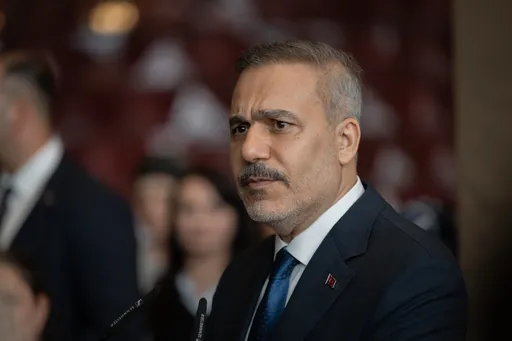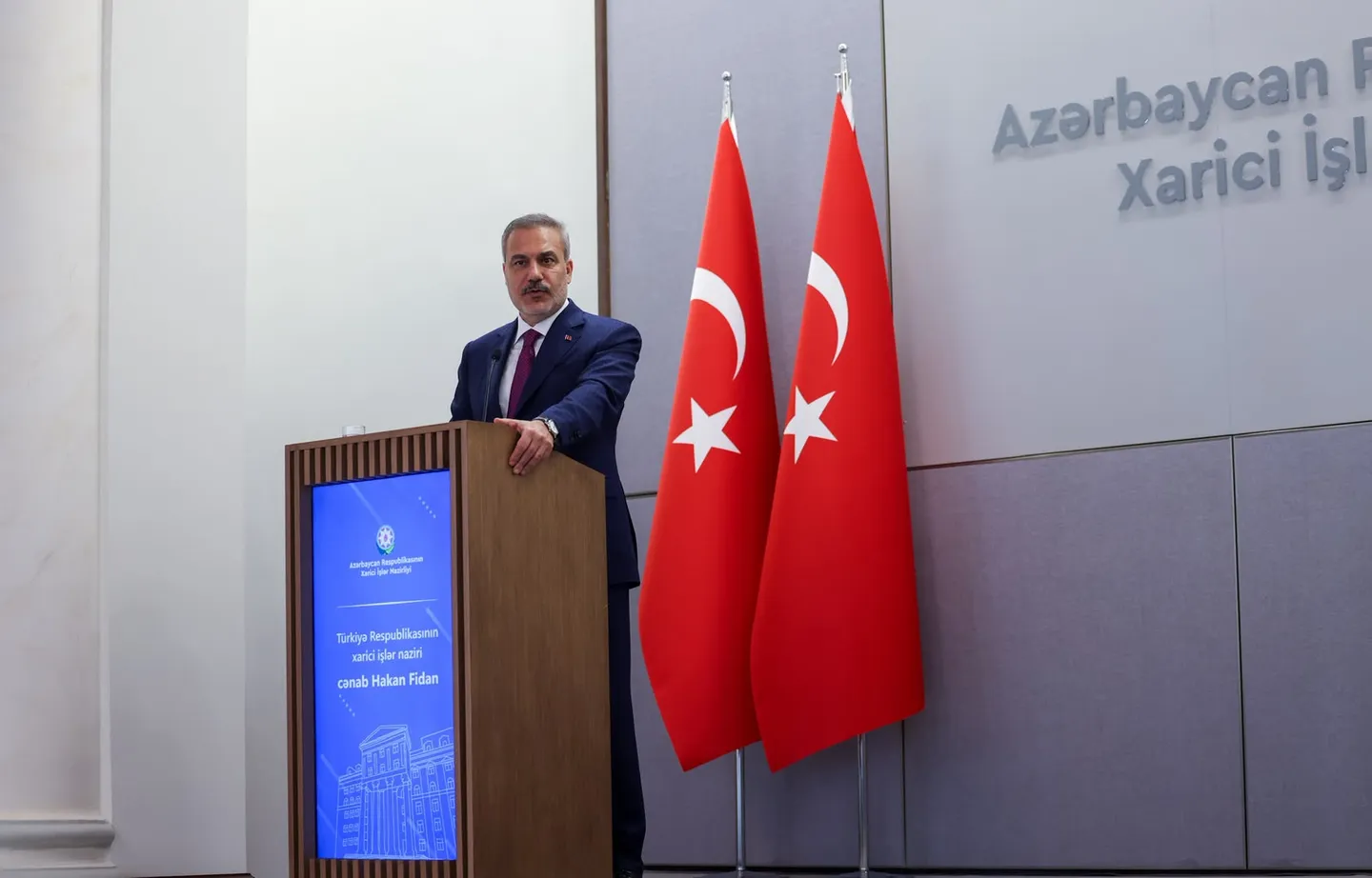
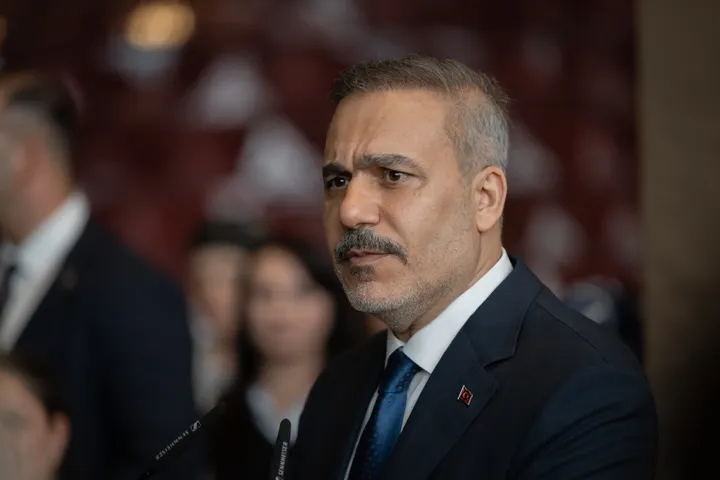
Türkiye's Foreign Minister Hakan Fidan has called for safe, uninterrupted, and free passage through the Strait of Hormuz and a swift return to the pre-war status quo, while warning against the further spread of the Russia-Ukraine war.
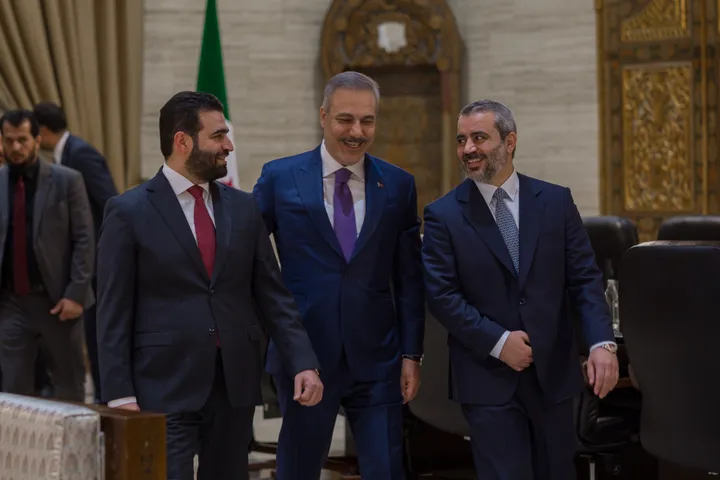
Speaking at a joint news conference with his Azerbaijani counterpart Jeyhun Bayramov in Baku on Tuesday, Fidan said developments in neighbouring Iran directly concern both Türkiye and Azerbaijan.
“Iran’s security, stability, and prosperity naturally have a direct impact on our region. In this regard, we want the current conflict to be resolved through diplomatic means as soon as possible,” he said.
Fidan said increasing reciprocal attacks have seriously undermined peace efforts, and called for an immediate end to actions fueling regional tensions.
“At the same time, safe, uninterrupted and free passage through the Strait of Hormuz must be allowed, and the pre-war status quo must be restored as soon as possible,” he said, adding that Türkiye remains in continuous contact with all relevant parties to help resolve the crisis.
Turning to the Russia-Ukraine war, Fidan said Türkiye has made major efforts since the beginning of the conflict to keep the Black Sea out of the fighting.
He said Ankara had largely succeeded in doing so through its strict implementation of the Montreux Convention and efforts such as the Black Sea Grain Initiative.
“However, increasing attacks on civilian vessels in the Black Sea in recent months have seriously harmed the safety of life, property, navigation, and the environment in the region,” Fidan said.
Noting that Turkish and Azerbaijani sailors had also lost their lives in the attacks, he said: “The spread of the war into the Black Sea and the threat it poses to the lives of our citizens and the activities of our companies is unacceptable.”
Fidan said Türkiye has conveyed the necessary warnings to the parties and believes common ground could be found if there is sufficient political will and good faith.
“We will continue to make every effort for peace,” he said, recalling President Recep Tayyip Erdogan’s position that “even the worst peace is better than war itself.”
Risk of wider war
Responding to questions, Fidan warned that the Russia-Ukraine conflict has intensified significantly over the past year and carries the risk of spreading beyond its current geography.
He said Türkiye’s position has remained unchanged throughout the more than four-and-a-half-year war, arguing that it was “a war that should never have started, should not spread, and should end immediately.”
Fidan pointed to Türkiye’s diplomatic efforts, including its role in the Black Sea grain deal, prisoner exchanges, and talks between Russia and Ukraine in Istanbul.
He said Ankara is also working with the parties on proposals aimed at preventing attacks on energy infrastructure and improving security in the Black Sea.
Fidan described the conflict as having transformed over the past year from a “war of attrition” into a “war of destruction,” with commercial facilities and infrastructure increasingly being targeted and civilian casualties rising.



“From time to time, there are statements about the possibility of the war spreading not only in the Black Sea but also to other European countries,” he said.
"We do not even want to think about it, let alone talk about it. The geographical expansion of the war is the last thing we want to see.”
Fidan warned that unless the war ends, energy prices, food security, and the environment will face greater risks, while the danger of the conflict spreading will increase.
Türkiye-Azerbaijan ties, regional connectivity
Fidan also highlighted the strategic relationship between Türkiye and Azerbaijan, saying the two countries remain bound by the principle of “one nation, two states.”
He said economic and commercial cooperation, as well as energy, transportation, and connectivity, constitute key pillars of bilateral ties.
Fidan described the Baku-Tbilisi-Kars railway as one of the most important components of the Middle Corridor and stressed the importance of ensuring its effective use.
He also highlighted plans to strengthen connectivity between Türkiye and Azerbaijan via Nakhchivan, including the Zangezur Corridor and the Kars-Igdir-Aralik-Dilucu railway.
“God willing, the Kars-Dilucu railway will be completed toward the end of 2029. Thus, a train coming from Azerbaijan will be able to reach Türkiye without interruption,” he said.
Fidan said such infrastructure would provide a significant logistical opportunity and strengthen the Turkic world’s access to Anatolia and Europe, while facilitating Türkiye’s access to Central Asia across the Caspian Sea.
‘Constructive approach’
On the South Caucasus, Fidan said Türkiye welcomed recent progress toward a final peace agreement between Azerbaijan and Armenia and Baku’s “constructive approach.”
“We want the South Caucasus to be associated not with conflicts, but with peace, transportation, energy, trade, and economic development,” he said.
Fidan also said Türkiye and Azerbaijan would continue deepening defence and security cooperation through joint exercises, training, experience-sharing, and growing cooperation between their defence industries.
He added that the Organization of Turkic States foreign ministers would meet in Ankara on October 29, followed by the organization’s 13th summit on October 30.
“We see this summit as a historic step that will consolidate the Turkic world’s common vision for the future,” he said.