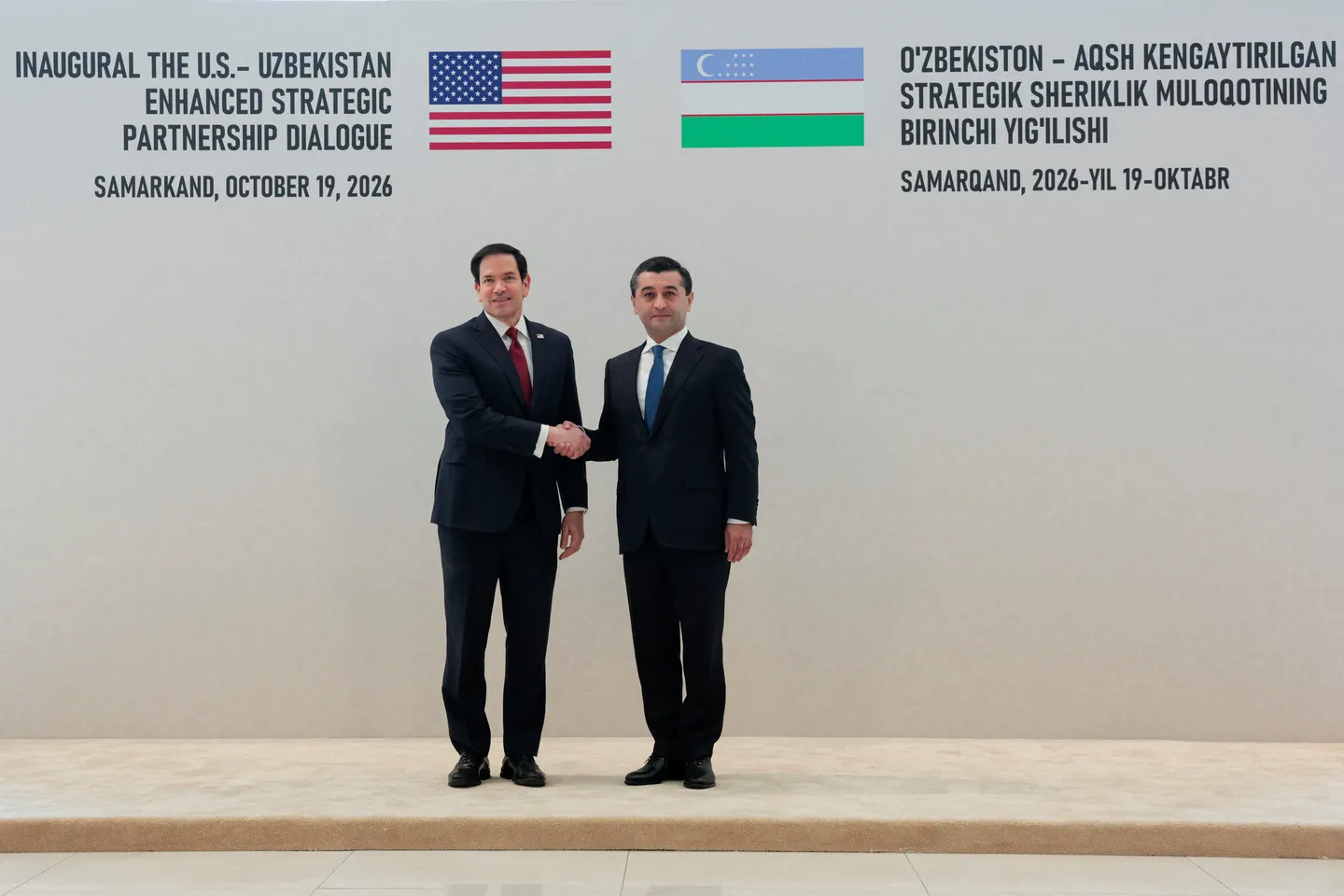
The United States wishes to be a "strong partner" for Central Asia, Secretary of State Marco Rubio has told journalists in Uzbekistan's Samarkand city, as he pushed for greater access for American companies during talks with regional leaders.
Before heading to India on a tour mixing diplomacy and commerce, Rubio arrived in the Silk Road city of Samarkand late on Sunday for negotiations with top officials from Kazakhstan, Kyrgyzstan, Tajikistan, Turkmenistan and the Uzbek hosts.
The leaders of the five former Soviet republics met US President Donald Trump at the White House in November last year, as the United States seeks stronger ties in a region with vast natural resources but where China has emerged as a top trade partner.
Heading a delegation including numerous business executives, Rubio visited Samarkand's old city, a historic staging post between China and the West, before meeting regional leaders.
"The United States wants to be a strong partner in Central Asia, obviously rooted in this country, but also all the neighbouring countries who want to do more business and trade with us," he told journalists on Monday.
"We have an incredible delegation, almost 300 American businesses that are here with us, and the opportunity to sign billions of dollars of agreements that will both enrich the countries in the region, but also benefit the United States economically," he said.
Later on Monday, the State Department said the US and Uzbekistan had concluded more than 50 contracts worth a combined $12 billion in sectors including tech, industrial modernisation, transport and energy.

Iran, Ukraine wars
With Washington stuck in a war with Iran and unable to halt Russia's invasion of Ukraine, Rubio has stepped up his foreign travel with recent trips to Europe and Latin America, while leaving Trump to handle the conflicts and the US mid-term elections.
But Rubio insisted this week's tour is of strategic importance.
"This is an important relationship," he said shortly before his departure. "There's countries you'd like to get to because we want to build our relationships with them."
Asked whether Washington's push in Central Asia was aimed at countering China's growing influence, Rubio replied: "It's competition."
"There's no part of the world in which we feel like America and American business should not have a fair shot to compete."
Rubio added: "This is not about coming here to say stop talking to somebody else or stop working with some other country. That’s not about that."


After Uzbekistan, Rubio will go to India where the US ambassador is Sergio Gor, who was born in Uzbekistan and is also the US special envoy for Central Asia.
The Central Asian states remain linked to Russia by energy pipelines and security and migratory networks, but Russian influence has eroded since the start of its invasion of Ukraine.
And China has reaped the benefits. It is now the main trade partner of all five nations.
Chinese companies have signed a number of energy-related deals, seeking to buy natural gas in Turkmenistan, uranium in Kazakhstan and rare earths in Tajikistan.
Cold War-era Jackson-Vanik amendment
In a joint statement after the talks, the US and the five Central Asian countries pledged to "strive for a Central Asia that returns to the center of the global economy", including through development of the Trans-Caspian trade route.
Also known as the Middle Corridor, the route links China to Europe through Central Asia, the Caucasus and Türkiye while bypassing Russia. It has attracted growing interest since Moscow's invasion of Ukraine.
Crossing Central Asia shortens delivery times while avoiding riskier routes, including the Red Sea-Suez Canal shipping corridor and overland routes through Russia, which have been complicated by Western sanctions.
On his second visit to India this year, Rubio will have stops in Mumbai and Jamnagar in Gujarat state. Both are major port cities.
"We're very close" to a trade deal with India, a second senior US official said of negotiations with India that have dragged on for months.
Rubio also highlighted Uzbekistan’s rapid economic expansion, observing that the country’s gross domestic product has grown at an annual rate of nearly eight percent.
He identified Central Asia's most populous nation as a cornerstone of regional stability and growth, pointing to emerging developments in the tourism and transport sectors, including ongoing discussions regarding direct commercial flights between the US and Uzbekistan.
When asked about the Cold War-era Jackson-Vanik amendment — a legislative restriction that still technically limits full normalised trade relations between the US and several post-Soviet nations — Rubio reaffirmed that the current administration favours its repeal.
"We are in favour of repealing it. There are a number of strong voices in Congress that are in favour of repealing it," he said, adding that legislative action remains pending before the US Congress.