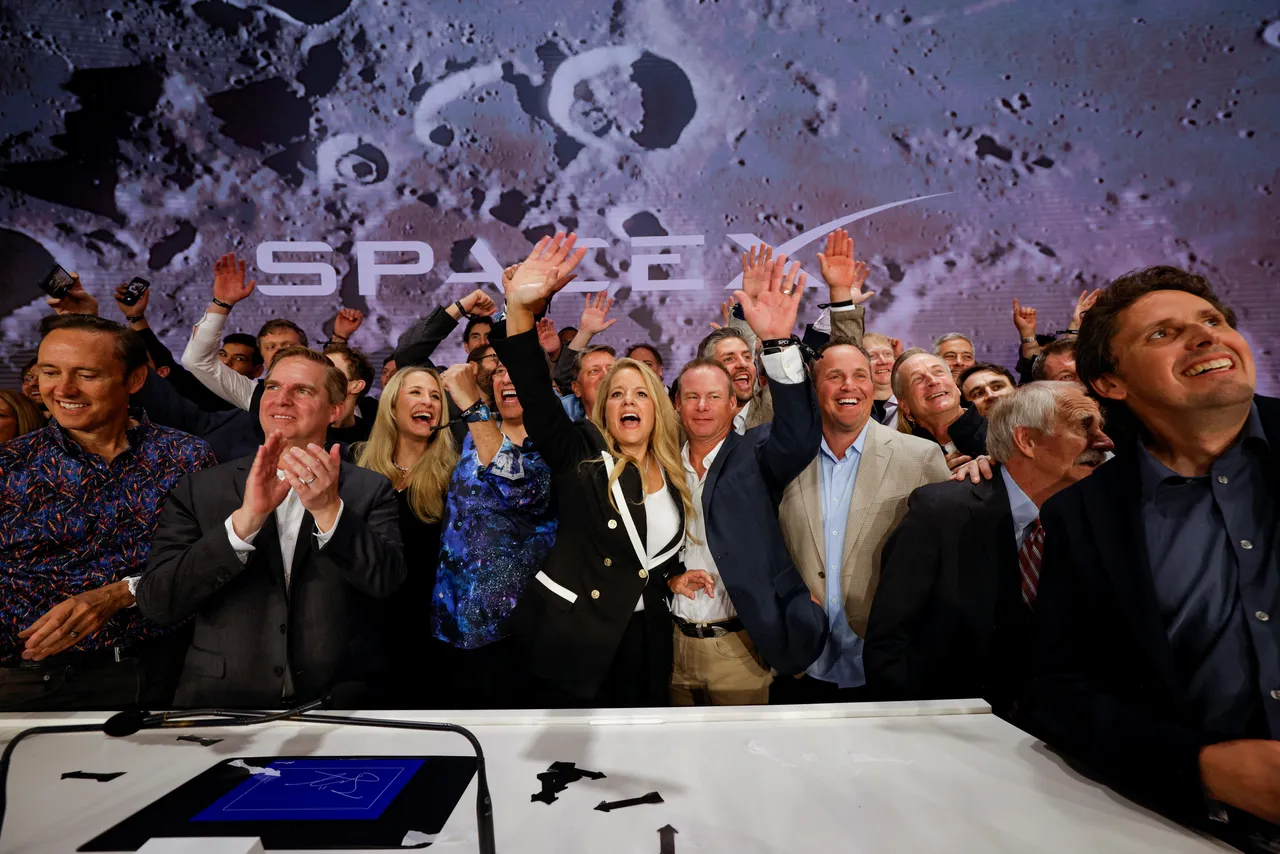
SpaceX’s record initial public offering has pushed Elon Musk’s rocket and satellite internet company into the upper tier of the world’s largest companies by market capitalisation, adding a major new name to a ranking dominated by technology, artificial intelligence and semiconductor firms.
The company priced its initial public offering at $135 per share, raising about $75 billion and giving SpaceX a market value of $1.77 trillion.
SpaceX shares rose on Friday shortly after debuting on public markets, climbing to $165 a share, around 22% above the $135 IPO price.
The surge lifted its valuation past $2 trillion, up from $1.77 trillion at listing.
At that level, SpaceX becomes the sixth-largest US-listed company, behind Nvidia, Alphabet, Apple, Microsoft and Amazon.
Unlike most companies at the top of the global market-cap table, SpaceX operates in a capital-intensive industry built around rocket launches, satellite communications, defence-related contracts and long-term space infrastructure.
It has become one of the most closely watched companies in the world over the past decade, driven by reusable rocket technology, NASA missions, the Starlink broadband network and its broader ambition to reduce the cost of access to space.
Starlink has expanded into residential, business, maritime, aviation and government services, making satellite internet one of the company’s most important growth drivers.
The listing marks a major shift in the global market-cap table.
Future orbital infrastructure



For years, the top ranks have been led by US technology platforms, chipmakers and Cloud-computing companies, while Saudi Aramco has remained one of the few non-US names among the largest firms. SpaceX adds a company whose valuation is tied to launch services, satellite-based connectivity and future orbital infrastructure.
Nvidia remains the world’s most valuable publicly traded company, with a market capitalisation of $4.96 trillion. Alphabet follows at $4.35 trillion, Apple $4.34 trillion, Microsoft $2.90 trillion, and Amazon at $2.60 trillion.
Taiwan Semiconductor Manufacturing Company, or TSMC, ranks sixth with a market capitalisation of $2.18 trillion, reflecting its central role in global semiconductor manufacturing. Broadcom ranks seventh at $1.83 trillion, supported by investor demand for chip and infrastructure software firms linked to the AI investment cycle.
Saudi Aramco ranks at $1.75 trillion and Tesla at $1.25 trillion.
The comparison is notable because Tesla had long been the main publicly traded company associated with Musk, while SpaceX’s listing gives investors direct exposure to another major Musk-led business with a different operating model and risk profile.
SpaceX’s offering suggests strong demand for companies associated with AI infrastructure, defence technology, satellite communications and next-generation transport systems.
The IPO debut has added a new space-focused player to the small group of companies valued above $1 trillion.
SpaceX shares are indicated to open at $155 on their Nasdaq debut, above the $135 per-share IPO price.
The blockbuster IPO has propelled Elon Musk into the rarefied ranks of trillionaires.
Already the world’s wealthiest individual by a substantial margin, he has now crossed the symbolic $1 trillion threshold. The fortune remains paper wealth, anchored in equity and options tied largely to SpaceX and Tesla.