 Carlos Ortega Sanchez
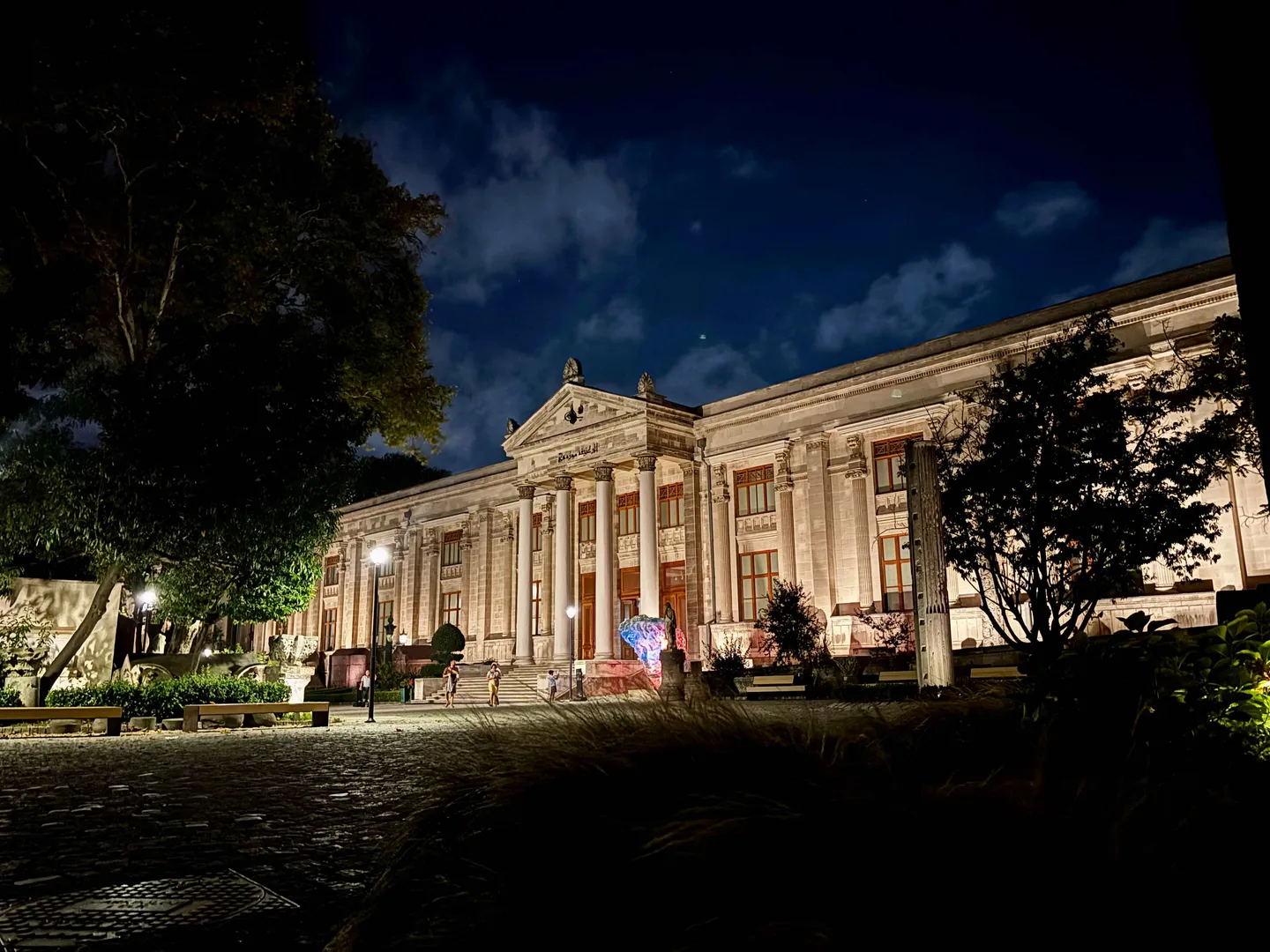
As night falls, the Istanbul Archaeological Museum takes on a different character.
Artificial lighting illuminates its facades, sculptures, and architectural details, turning daytime grandeur into a more intimate journey where light and shadow bring each feature to life.
This transformation is part of Türkiye's night museum initiative, which allows visitors to explore selected museums and archaeological sites after dark between June and October.
It has attracted visitors like Elif, a 29-year-old Turkish woman who has visited Ephesus and Side at night, two ancient cities on Türkiye's Aegean and Mediterranean coasts, and frequently visits the Nevsehir Open-Air Museum in Cappadocia.
"These places, which we usually explore during the day almost through the eyes of an archaeologist, offer a truly spectacular visual experience at night," she tells TRT Español. "I think they give you a much stronger sense of what it was like to live in that era."
For her, visiting these sites at night offers something that a conventional daytime visit cannot.
"These initiatives breathe life into these places and allow you to experience emotions you haven't felt before."
From one night to a whole summer
While "museum nights" have become established as one-off cultural events across much of Europe, Türkiye has taken the concept a step further, making it a summer-long initiative since 2024.
Ephesus, Hierapolis and Side were among the first major sites to participate.
That year, the programme attracted 395,212 visitors, reflecting growing interest in experiencing the country's cultural heritage in a new light.
In 2025, the initiative expanded to include additional museums and archaeological sites, marking a significant increase in scale.
Speaking to TRT Español, Serkan Geduk, head of the Museums Department at the General Directorate of Cultural Heritage, says the initiative, launched in 2024, aims to preserve cultural heritage, pass it on to future generations, and promote tourism.
"Our goal is to make Türkiye's rich cultural heritage accessible at any time of the day and to reinforce our vision of sustainable tourism," says Geduk.
The 2026 season, which ran from June to October, opened 22 locations to visitors, including 11 museums and 11 archaeological sites.
In Istanbul, the programme includes the Istanbul Archaeological Museums, the Museum of Turkish and Islamic Arts and Galata Tower.
The latter is an exception, with night visits year-round.
Geduk tells TRT Español that the programme expanded to 27 museums and archaeological sites by 2025, drawing more than one million visitors.
Among the most popular locations, he cites Ephesus, Hierapolis, Galata Tower and the Bodrum Museum of Underwater Archaeology.
The figures point to strong demand. Between June and July 2026, Ephesus welcomed 213,192 visitors during its evening opening hours, with more than 156,000 in July.
For Seda Cicekli Ayyildiz, a researcher at the Faculty of Tourism at Bolu Abant Izzet Baysal University and co-author of one of the first academic studies specifically examining night-time museum experiences in Türkiye, the key is to see the initiative as more than simply an extension of opening hours.
"Visitors no longer want to be passive observers; they want to be part of the experience," Ayyildiz tells TRT Español.
According to the researcher, night visits enhance the sensory experience of museums and archaeological sites, creating a deeper and more memorable connection with cultural heritage.
In Türkiye, where temples, theatres and ancient cities remain part of the landscape, nightfall offers a different perspective on this heritage. Lighting highlights details, the surroundings grow quieter, and history feels much closer to visitors.
Practical reasons also drive this transformation. Many of Türkiye's major archaeological sites are in regions where high summer temperatures make daytime visits difficult, particularly during the hottest hours.
"During the summer months, the high temperatures often make it difficult to visit during the day," says Geduk, adding that evening opening hours allow visitors to explore museums and archaeological sites "in a cooler and more pleasant atmosphere", particularly at Ephesus, Hierapolis and Side.
Ayyildiz believes the initiative has even greater potential: extended opening hours make cultural heritage more accessible, help spread tourist crowds, and link museum visits to evening activities in their destinations.
The ministry shares this view, highlighting the programme's ability to spread tourist activity throughout the day, benefit local economies and strengthen cultural tourism.
What the darkness reveals
But reducing the appeal of night-time museum visits by lowering temperatures and extending opening hours would overlook something more profound.






"At night, a museum or archaeological site becomes a very different place from the one we see during the day," Omer Yilmaz, an architect specialising in tourism design, tells TRT Español.
"During the day, we perceive the whole; at night, our field of vision narrows and we concentrate on what the light shows us."
A column, a wall or a relief can take on prominence that might go unnoticed in uniform daylight. Lighting is no longer simply a means of making a monument visible; it begins to shape how visitors move through and interpret the space.
"In nighttime museology, lighting becomes a fundamental design tool that directly determines how the visitor interprets the space," says Yilmaz.
This means deciding what to illuminate, what to leave in the background and which routes visitors should follow. It also means accepting something that may seem contradictory: not everything needs to be visible.
"We must not forget that darkness is also part of the design," he says.
Ayyildiz agrees that lighting can become a storytelling tool. Through the interplay of light and shadow, it can draw visitors' attention to columns, reliefs and architectural details that might otherwise go unnoticed during the day.
For her, success is simple: "The ideal is not for the visitor to say 'how well lit', but 'I have never seen this place like this'."
She suggests lighting should draw attention to the heritage, not itself.
Canan, 36, who visited the Istanbul Archaeological Museums this summer, highlights another effect of the darkness: silence. Having visited several times during the day, she found the night-time experience "very different".
"Going at night made the atmosphere quieter, and I really liked that. I think that, above all, I enjoyed that feeling of silence," she tells TRT Español.
Night-time visits also offer new possibilities for designing exhibition spaces. Canan, for example, points to the potential for further developing the lighting of artefacts displayed in gardens and outdoor areas.
There is no single approach. A Roman theatre, an archaeological museum, a rock-cut settlement or a hoyuk (a mound formed by successive layers of human settlement) each offers different possibilities.
Each site's character can determine what to illuminate, which routes to create, and what kind of night-time experience to offer.
The experience can also extend beyond the visual. Ayyildiz suggests activities such as archaeology nights under the stars, storytelling sessions, workshops and events incorporating music, literature and gastronomy, allowing visitors to engage with heritage through more than just sight.
When the night ends
The 2026 night museum season concluded this month across much of Türkiye, although some Istanbul sites remain open after dark. While locations such as Ephesus, Side and Goreme extended their opening hours only until mid-to-late October, Galata Tower will continue welcoming visitors at night throughout the year.
The ministry is already looking ahead.
"Our ministry continues to carry out the necessary infrastructure work to more effectively extend night museology throughout the country," says Geduk.
The aim is to include more museums and archaeological sites and gradually expand the programme.
For those who have experienced it, the appeal is clear. Elif says she would return and recommends the experience to others.
"I think it transports you to completely different universes and renews your way of looking."
Canan agrees: "I would repeat the experience. In fact, I would also like to visit Topkapi Palace and Galata Tower at night. I hope that this initiative will continue in the coming years as well".
With visitor numbers more than doubled, the programme is now entering a new phase. The ministry plans to expand its reach by adding sites, using data-driven planning, and developing new experiences tailored to each destination.
For museum specialists, architects, and heritage managers, the challenge is to ensure these experiences respect each site's character.
"The aim should not be to turn a historic space into a set or a place of entertainment," says Yilmaz,
"but to allow the visitor to discover in a different way, at night, spatial and historical features that they might not perceive during the day."
For Ayyildiz, the objective "should not simply be to attract more people, but to encourage more people to establish a quality, conscious and sustainable relationship with cultural heritage".
Perhaps that is the real appeal of night-time museum visits. It is not simply about illuminating historic sites so they can be seen as they are in daylight, but about discovering how nightfall can change the way we experience and understand history.
This article was first published on TRT Español.