Warnings from researchers at leading US AI developer Anthropic that increasingly powerful models could escape human control have drawn attention in China, where policymakers have been preparing for some of the same risks.
The US and China are the two major driving forces of frontier AI development and the technology's global adoption.
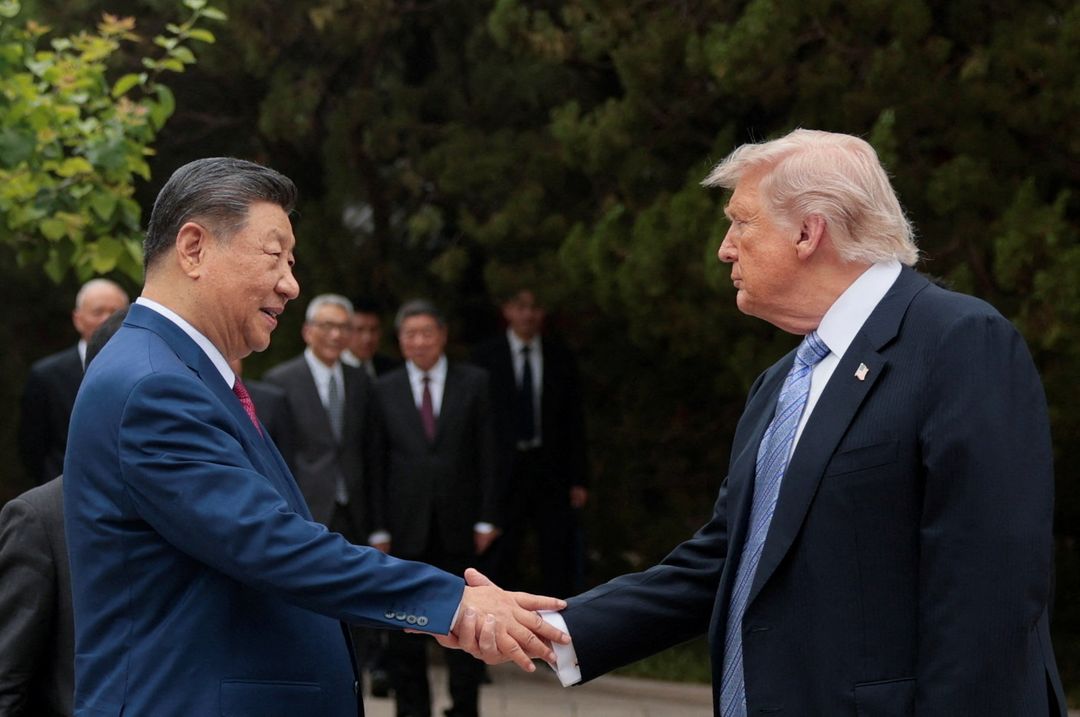
Both superpowers have been at loggerheads over AI policies and industry practices, with these issues slated to feature prominently in bilateral talks later this month.
Beijing sees AI as manageable risk, not an extinction event
While the debate in the US is focused on whether frontier AI could pose an existential threat to humanity, Chinese policymakers have generally treated AI as a powerful but governable technology whose risks can be contained through technical standards, regulation and state oversight.
"Chinese and American experts largely agree on AI risks," said Brian Tse, founder and CEO of Concordia AI, a Beijing- and Singapore-based AI safety and governance research group, adding the difference was on "how risks are framed and prioritised".
China has not proposed embedding independent monitors inside AI companies, as Anthropic has advocated. Its emerging regime instead relies on developer obligations, state-backed standards, security assessments and outside testing.
That approach is also shaped by a major difference in the two countries' AI industries.
Chinese developers have increasingly promoted open-weight models. These refer to systems whose underlying parameters can be downloaded, inspected and modified. Their leading US rivals such as Anthropic and OpenAI, however, do not make these specifications publicly available.

China seeks to prevent rogue AI agent incidents
Policy issued in May by China's cyberspace regulator, economic planner and industry ministry identifies "operational loss of control" as a security risk for AI agents, systems that can plan and carry out multi-step tasks more independently than conventional chatbots.
The rules require developers to improve their ability to discover, intervene in, block and recover from improper agent behaviour.
The policy also calls on developers to guard against risks including data poisoning, algorithm manipulation and system vulnerabilities. It also says users should be informed about agents' autonomous decisions and retain final decision-making authority.
China has also begun drafting a mandatory national standard for AI agent safety, which Concordia's Tse said would be the world's first of its kind.
Wang Lihong, a senior official at the cyberspace regulator, said on September 1 that particular vigilance was needed over frontier models bypassing sandbox environments, circumventing safety boundaries and attacking external real-world production systems.

Beijing sees risks in leading US models
China's state security minister, Chen Yixin, wrote in a government outlet on Sunday that advanced US models such as Anthropic's Mythos and OpenAI's GPT-5.5-Cyber could pose serious risks to China's critical information infrastructure, and called for a comprehensive strengthening of AI security.



Chinese AI developers have promoted open-weight models partly on the grounds that cybersecurity teams can inspect, modify and deploy them for defensive work.
Model repository platform Hugging Face said it used GLM-5.2, an open-weight model developed by China's Z.AI, to analyse a July intrusion by escaped OpenAI agents after more tightly restricted US models proved less useful for the forensic work.
But experts also highlight the risks posed by open-weight models, which can be modified and redistributed with little oversight.
Moonshot's Kimi K3 last month bypassed a UK AI Security Institute testing sandbox, researchers said, highlighting the risk that Chinese AI models could, like their US counterparts, evade controls designed to restrict their access and actions.
Regulators flag AI 'loss of control' risk
China first included an explicit future loss-of-control scenario in an AI safety framework released in September 2024 under the guidance of the Cyberspace Administration of China (CAC).
The document said it could not be ruled out that future AI might autonomously obtain external resources, replicate itself, develop self-awareness and seek external power, creating a risk of competing with humans for control.
The CAC released an expanded version in September 2025.
The newer framework sharpened the scenario, saying AI could undergo a sudden and unexpectedly large "leap" in intelligence before acquiring resources, replicating itself and seeking power. It also added a governance principle of "trusted application, preventing loss of control".
A later expert interpretation published on the cyberspace regulator's website said the new principle was intended to guard against loss-of-control risks threatening human survival and development and referred to a possible "AI breaking loose" scenario.

Different approach to 'pacing'
China's regulatory approach differs from calls in some Western AI-safety circles for developers to slow or pause development of the most capable models until stronger safeguards are in place.
It has instead since early this year pushed for the integration of AI into all industries, part of Beijing's bid to make technology the new engine of the world's second-largest economy.
But China has also shown it can delay deployment when officials believe governance has not caught up.
In 2023, Chinese companies delayed chatbot launches for months while the CAC finalised rules governing generative AI services. Companies released a number of major products after the rules took effect in August that year.