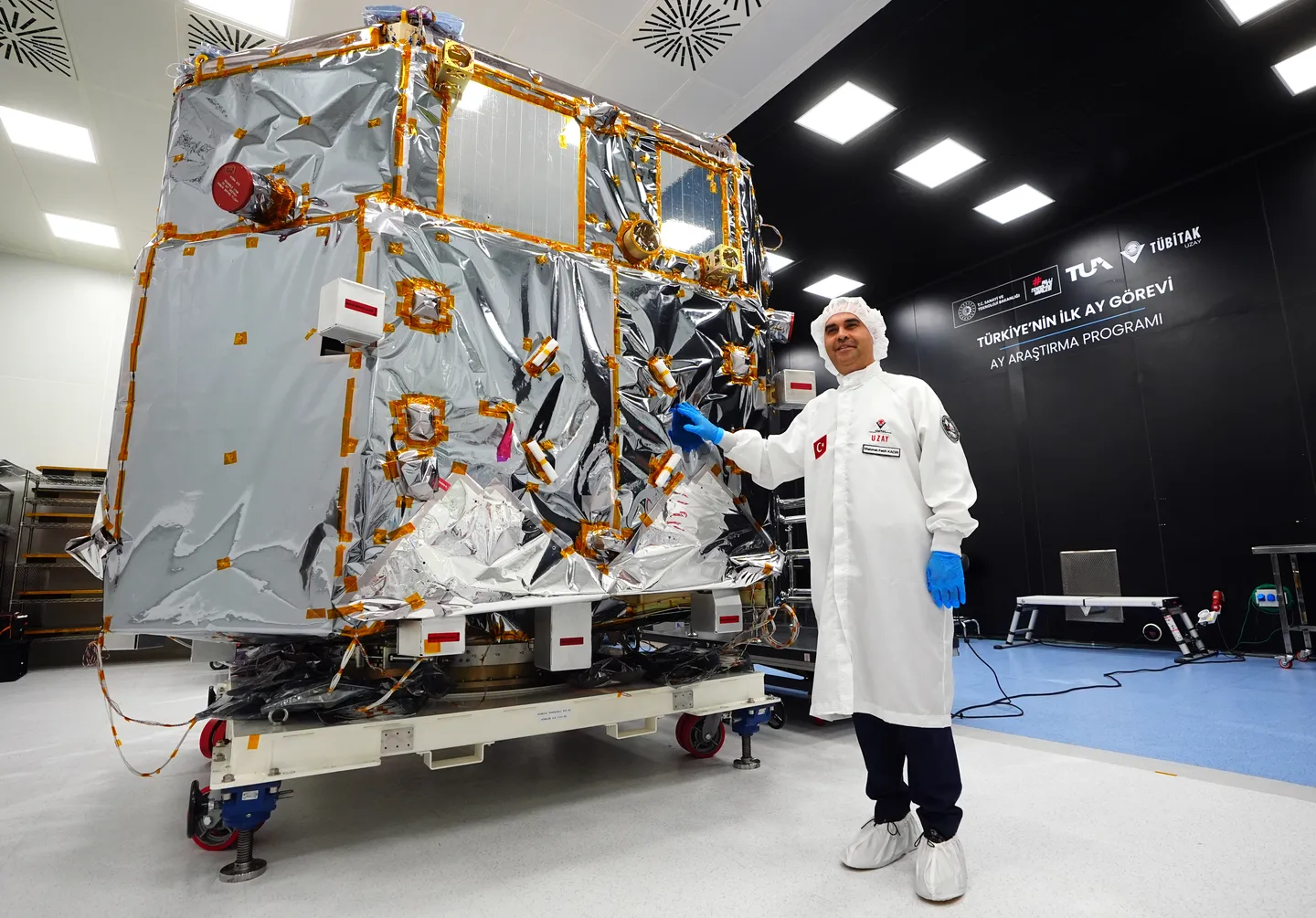
Türkiye completed the production and assembly of its first lunar spacecraft, transferring the 3.5-metric-tonne craft to Turkish Aerospace Industries (TAI) for environmental testing, the industry and technology minister said in a recent statement.
Mehmet Fatih Kacir said the craft is scheduled for launch from the Kennedy Space Center in early 2027 and will take around two months to reach a 100-kilometer (62.13-mile) polar orbit around the Moon.
The craft will operate in lunar orbit for three months, with the potential to extend its operation to a year and a half, during which solar winds, water formation, magnetic fields and surface radiation will be evaluated through homegrown scientific instruments.
Kacir stated that these efforts have been made to realise “a fully independent Türkiye in critical technologies,” following the country’s similar approach in its defence industry.
The spacecraft includes critical flight, communications and power systems developed for the previous Imece and Turksat 6A satellite projects, boasting an 80% domestic production rate.
“The further tests will verify the spacecraft’s ability to withstand the harsh conditions it will encounter during launch and in the space environment,” he said. The craft will then be transferred to a new cleanroom facility of the Turkish Scientific and Technological Research Institution (Tubitak) Space for final inspections.
The craft will use a homegrown hybrid propulsion system for orbit-raising maneuvers and a final controlled deceleration burn to reach the lunar surface at the end of the primary scientific mission.




“Only eight countries have carried out lunar missions so far, and when we implement our programme, Türkiye will become the ninth country,” the minister noted.
These developments follow the country’s recent accession to the Artemis Accords, signed to promote global cooperation in the peaceful exploration of the Moon and deep space.
Kacir stated that development of the Turksat 7A communications satellite has begun alongside the design phases of the Imece-2 and Imece-3 Earth observation satellite constellations.
Meanwhile, Ankara is constructing a spaceport in Somalia to eventually provide independent access to space and reduce reliance on foreign launch facilities.
The Turkish government is also collaborating with the Turkish Space Agency and the Middle East Technical University (METU) to establish a space tech development zone in Ankara to extend the rapid growth of Turkish defence into the country’s space sector by integrating more tech startups with the national space manufacturing ecosystem.
The southwestern coastal city of Antalya will host the 77th International Astronautical Congress (IAC 2026) from Oct. 5-9 to showcase these expanding capabilities to nearly 10,000 global participants.