 Ege Kanik
In German building regulations, a Brandwand is a solid wall between two adjoining buildings.
It does not extinguish a fire. It only stops the flames from spreading next door long enough for the fire brigade to arrive.
German politics has long relied on a similar idea.
Known as the Brandmauer, or “firewall”, it is a strict political consensus among Germany’s mainstream parties that they will not form coalitions or governing agreements with the far-right Alternative for Germany (AfD).
For years, the Brandmauer has kept the AfD isolated from government. But as the party attracts a growing share of the electorate, particularly in eastern Germany, that consensus is coming under unprecedented pressure.
On September 6, voters in the eastern federal state of Saxony-Anhalt cast their ballots in an election that has seriously questioned the establishment of German politics and the system.
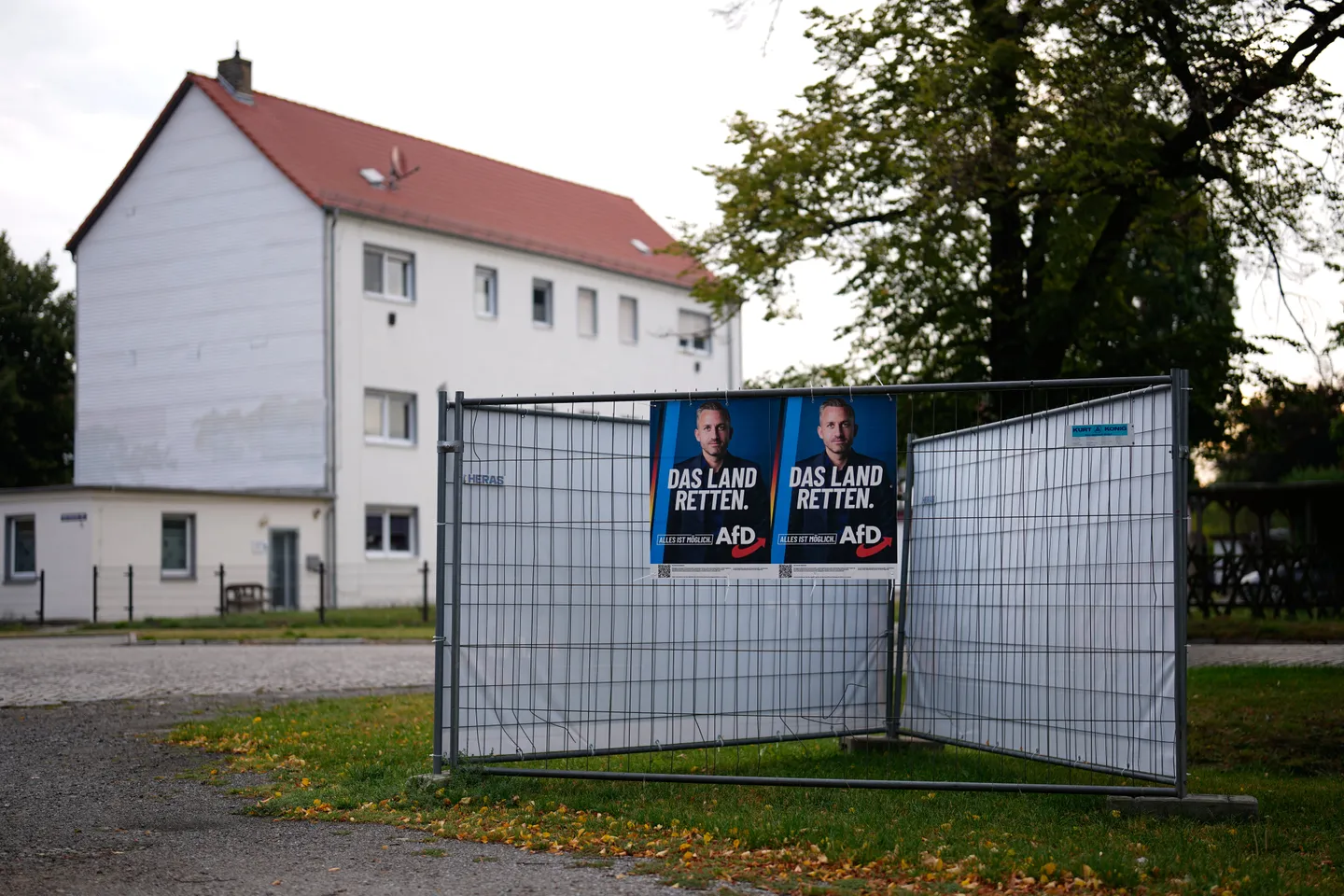
The AfD had been polling at a staggering 43 percent ahead of the vote, a significant share in German politics.
Their lead candidate Ulrich Siegmund represents a regional faction that the domestic intelligence agency has explicitly classified as a proven right-wing extremist organisation.
The agency notes that these factions promote an ethnic understanding of national identity that fundamentally conflicts with the democratic constitutional order habituated within the country.

On paper, the firewall held again on September 20.
In Mecklenburg-Vorpommern the AfD came first with 38.2 percent, yet the Social Democratic premier Manuela Schwesig announced talks with the Left Party and the Greens, leaving the AfD, in its lead candidate’s words, as the “sole opposition”.
In Berlin the AfD rose from 9.1 to 16.3 percent.
Two weeks earlier it had taken 43.8 percent in Saxony-Anhalt, a result that, according to Chatham House, no party labeled extreme right had achieved in a German state election since 1945.
Yet no AfD politician sits in a state cabinet. The concept carries more weight than its technical name suggests.
It draws on the lesson of 1933, when conservative elites believed they could tame Hitler by bringing him into government.
In 2018 the Christian Democrats (CDU) formalised it, rejecting “coalitions and similar forms of cooperation” with both the AfD and the Left Party.
When CDU legislators in Thuringia helped elect a premier with AfD votes in 2020, Angela Merkel called it “unforgivable,” and he resigned within days.
Such a firewall rests on three pillars.
The first is arithmetic, meaning enough seats outside the AfD to govern. The second is legitimacy, the public’s acceptance that exclusion defends democracy rather than a cartel of incumbents.
The third is performance: governments formed behind the wall must deliver. September strained all three at once.
Saxony-Anhalt shows the arithmetic failing. The AfD holds 39 of 83 seats, and the CDU, Social Democrats, Greens and Left Party together hold exactly 39.
The remaining five belong to the Sahra Wagenknecht Alliance (BSW), which has agreed to exploratory talks with the AfD.
Because a third ballot for premier needs only a plurality, the CDU cannot stop Ulrich Siegmund, whose state party the regional intelligence service classifies as confirmed right-wing extremist, without Left Party votes that its own resolution forbids.
A porous wall
The firewall has left the CDU choosing between two of its own taboos.
Mecklenburg-Vorpommern shows the price of holding the line.
The CDU fell to 4.9 percent the first time it has failed to enter a German state parliament, and the AfD, with 32 of 71 seats, will be the only opposition.






A parliament in which the largest party is also the sole opposition hands that party every grievance against the next government.
Legitimacy is eroding too.
In February, a Cologne court ruled that the federal intelligence agency may not, for now, label the national AfD as confirmed extremist. Locally, the wall is porous.
In the town of Demmin, CDU and AfD representatives voted together against continuing a federally funded democracy program, and an independent district administrator argued that people “should at least be able to see what happens when the AfD governs”.
Abroad, US President Donald Trump celebrated the Saxony-Anhalt result, and Chancellor Friedrich Merz postponed a call with him. A boundary contested from the town hall, the courtroom and the White House is hard to sell as a national consensus.
Performance is the weakest pillar for the federal government.
The Brandmauer implicitly promises that the parties behind it will govern better.
Yet only 13 percent of Germans are satisfied with Merz and 15 percent with his government, according to ARD’s DeutschlandTrend, while the AfD leads national polls at around 28 percent, nine points ahead of the CDU.
Merz called the Mecklenburg-Vorpommern result a “disaster,” saying his party had been “ground down” between the AfD and the Social Democrats.
There is also an economic aspect of this shift.
In Saxony-Anhalt, 65 percent of voters who called their finances poor chose the AfD, against 37 percent of those doing well and popularity of the far-right is also spreading among unsatisfied middle classes all around Europe.
Explaining the situation as primarily a choice of “lower” or less educated echelons of the society.
The limits of firewall
The state lost Intel’s planned Magdeburg chip plant, once billed as the largest foreign investment in German history, when the company abandoned it in 2025.
Energy costs since the break with cheap Russian gas, and the fiscal weight of support for Ukraine, feed a sense that decisions made in Berlin and Brussels are paid for in the east.
That explains more than the familiar story of East German nostalgia for Moscow in contrast to many believe among the media. There is also fear of a possible AfD government would deter skilled workers and companies.
Berlin adds another layer. The Left Party came first with 25.7 percent, and its lead candidate Elif Eralp, whose parents came from Türkiye, could become the city’s first governing mayor with a migrant background.
The Left is not the AfD. But for a CDU whose 2018 resolution excludes both, being squeezed from two sides leaves less and less room behind a double firewall.
Europe offers no clean exit. Belgium’s cordon sanitaire against Vlaams Belang and its predecessor has broadly held since 1989. Sweden’s center-right has governed with the support of the Sweden Democrats since 2022.
The Dutch coalition that included Geert Wilders’ PVV collapsed within a year. Italy offers another model, where Giorgia Meloni’s government has at times aligned more closely with the political mainstream after taking office.
Neither exclusion nor inclusion offers a simple solution. What matters is whether mainstream parties use the time a firewall buys them.
That is the real lesson of September.
Relying solely on the Brandmauer to protect democratic institutions is no longer a viable long-term strategy. If established parties want to halt the AfD’s momentum in upcoming elections, they will need to look beyond the rhetoric of defending democracy.
That means addressing voters’ economic frustrations, streamlining a sluggish bureaucracy and showing that centrist coalitions can deliver on the domestic and foreign policy issues that affect everyday life.
Otherwise, the firewall may not just fail to hold back the tide. It will become the very structure that traps the political centre as the ground collapses beneath it.