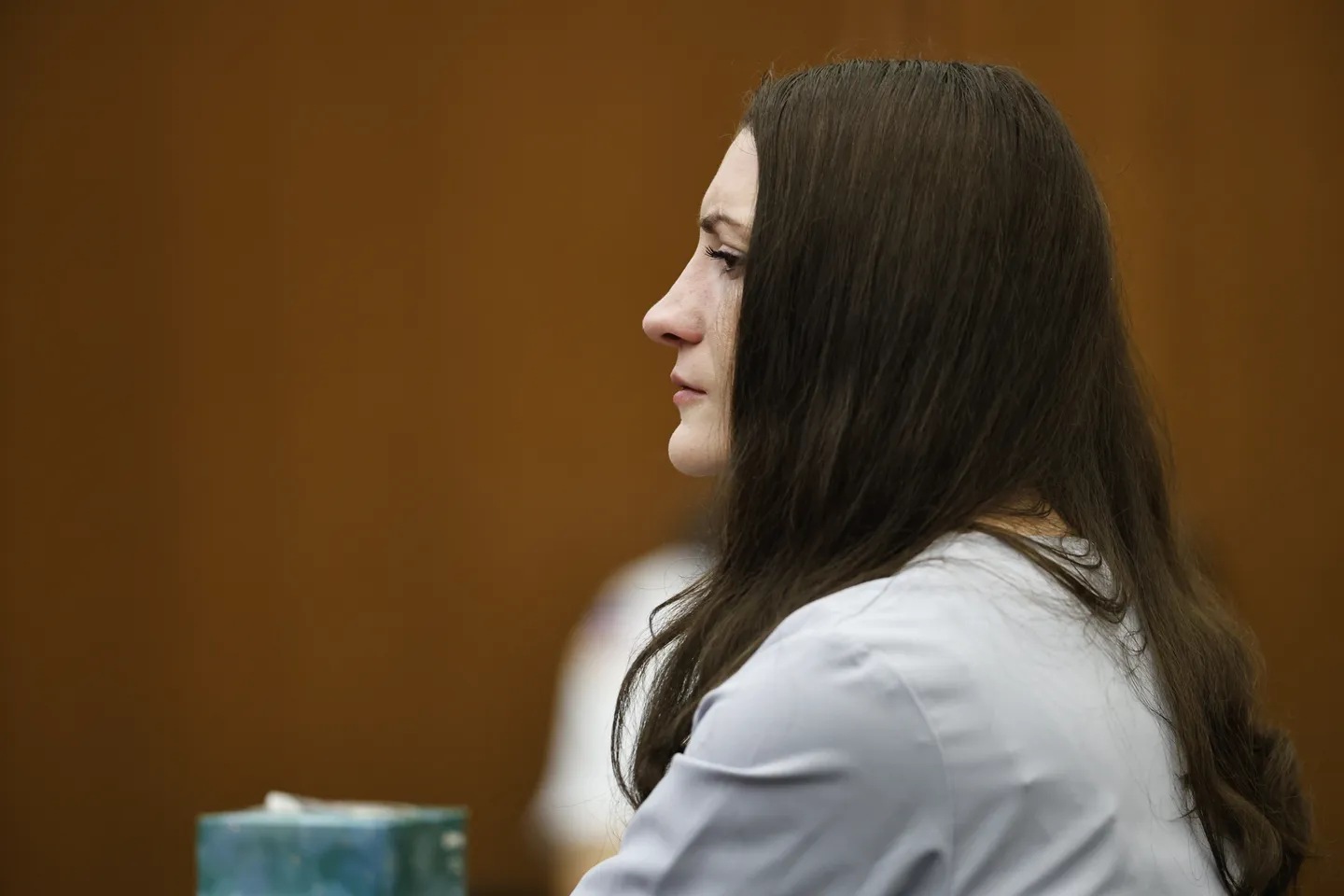
A US judge has declared a mistrial in the high-profile case of an American woman who killed her three children but put his decision on hold to allow the defence to appeal the decision.
Judge William Sullivan said on Friday that he was freezing his mistrial ruling in the trial of Lindsay Clancy to allow her lawyer to file an appeal with a higher court.
The jury has been deadlocked 11-1 with the majority apparently leaning towards finding the 36-year-old Clancy not guilty by reason of insanity.
The dramatic developments came after the jury sent a note to the judge on Friday morning saying that it was with a "heavy heart" that they were unable to reach a verdict in the case, which has cast a spotlight on maternal mental health.
A week into tense deliberations over whether Clancy should be held criminally responsible for killing her three young children, the courtroom in Plymouth, Massachusetts, descended into turmoil after the jury foreperson sent the judge an explosive note.
The murder trial of Clancy, a Massachusetts mother who has admitted killing her three young children, has entered an uncertain final phase.
Jurors deliberated for more than 28 hours without reaching a decision, according to CBS Boston.
The case has drawn intense attention in the US not because there is serious disagreement over who killed the children, but because of the question the jury must answer about Clancy’s state of mind: Was she legally responsible for deliberate killings, or was she so severely mentally ill that she could not appreciate their wrongfulness or control her conduct?
That question has also divided observers outside the courtroom.
Some see the case as a catastrophic example of postpartum mental illness and failures in maternal mental health care. Others argue that the public sympathy directed toward Clancy risks eclipsing the three children and turning a psychiatric diagnosis into an excuse for their deaths.
Supporters say Clancy was failed by a system that did not recognise the severity of her illness despite repeated requests for help. Critics argue that mental illness should not erase accountability for three deliberate acts.
What happened to the Clancy children?
On January 24, 2023, Clancy was at the family home in Duxbury, about 56 kilometres (35 miles) southeast of Boston, with her daughter Cora, 5, son Dawson, 3, and 8-month-old son Callan.
Her then-husband, Patrick Clancy, left the house to collect medicine; he testified at Plymouth Superior Court, according to WCVB. During his absence, Lindsay Clancy strangled the children with exercise bands, according to evidence presented at the trial.
She then cut her neck and wrists and went through a second-floor window. The fall caused spinal injuries that left her paralysed from the waist down. Cora and Dawson were pronounced dead that night, while Callan died in hospital three days later.
Clancy pleaded not guilty to three counts of first-degree murder. Her lawyers do not dispute that she killed the children; instead, they argue that she was not criminally responsible because she was experiencing postpartum psychosis.
What is the prosecution’s case?
Prosecutors say Clancy was mentally unwell but remained capable of planning, making choices and understanding that killing her children was wrong.
They have pointed to her apparently coherent behaviour on the day of the killings. She took Cora to a paediatric appointment, exchanged messages and photographs with her husband, ordered dinner and looked up directions to the restaurant.
The prosecution argues that she sent Patrick on two errands and checked the travel time to create a window in which she would be alone with the children.
Prosecution witnesses also testified that the clinicians who treated Clancy before the killings had not observed psychosis.
Expert witnesses called in rebuttal questioned her later account of hearing a male voice command her to kill the children and herself, describing elements of the reported hallucination as inconsistent with their clinical experience.
The prosecution’s position is that depression, anxiety or even another serious mental disorder does not automatically remove criminal responsibility. It argued that Clancy acted deliberately and knew her actions were wrong.
What does the defence argue?
The defence has portrayed the killings as the endpoint of a months-long psychiatric collapse after the birth of Callan in May 2022.
Testimony described severe insomnia, anxiety, weight loss, depression, suicidal thinking and intrusive thoughts about harm coming to the children. Clancy sought help repeatedly, saw several providers, was briefly hospitalised, and received numerous psychiatric prescriptions.
A Boston Globe review of court records found that she was prescribed 13 different psychiatric medications in the four months before the deaths.
Her lawyers argue that the fragmented treatment and frequent medication changes failed to identify an underlying bipolar disorder and worsened her condition. They say she entered a psychotic state on January 24 and experienced a command hallucination telling her to kill the children and then herself.
Defence experts testified that Clancy was psychotic and lacked the capacity required for criminal responsibility.
Her lawyers have also stressed that she had no criminal record and had previously been regarded by relatives, friends and colleagues as a loving and attentive mother.








What is postpartum psychosis, and does a diagnosis decide the case?
Postpartum psychosis is a rare psychiatric emergency marked by symptoms that can include delusions, hallucinations, severe confusion, paranoia, insomnia and rapid changes in mood.
It is often associated with bipolar-spectrum illness.
But the medical and legal questions are not identical. The jury does not merely have to decide whether Clancy had postpartum psychosis, bipolar disorder or another mental illness.
Under the Massachusetts Trial Court’s model jury instructions, a person is not criminally responsible if, because of a mental disease or defect, the person lacked the substantial capacity either to appreciate the wrongfulness of the conduct or to conform the conduct to the requirements of the law.
Once the issue is properly raised, the burden remains on the prosecution to prove criminal responsibility beyond a reasonable doubt.
That means jurors could believe Clancy was seriously ill and still convict her if they conclude that the illness did not meet the legal threshold.
What is happening with the jury?
The trial began in late July in Plymouth Superior Court and included 22 days of proceedings, more than 80 witnesses and hundreds of exhibits, according to CBS Boston’s courtroom coverage. Eighteen jurors heard the case.
For each child, jurors have five possible verdicts: guilty of first-degree murder, guilty of second-degree murder, guilty of manslaughter, not guilty, or not guilty by reason of lack of criminal responsibility.
A first-degree murder conviction carries mandatory life imprisonment without parole. Second-degree murder carries life with the possibility of parole, while manslaughter carries a term of years.
A finding of no criminal responsibility would not mean Clancy simply walks free. Section 16 of Chapter 123 of the Massachusetts General Laws allows hospitalisation for evaluation, followed by an initial six-month civil commitment and additional one-year commitments if the legal requirements continue to be met.
The jury began deliberating on August 27 and asked to examine evidence including Clancy’s prescription bottles and the knife she used to injure herself.
After twice reporting that it was deadlocked, Judge William Sullivan delivered a special instruction known as a Tuey-Rodriguez charge, asking jurors to reconsider one another’s views without surrendering honestly held convictions merely to reach a result.
If the jury remains unable to reach a verdict, the judge could declare a mistrial, leaving prosecutors to decide whether to try Clancy again.
What has her husband said?
Patrick Clancy, is the father of the three victims, the person who discovered the scene, and a witness whose testimony supplied important evidence to both sides.
Called as the prosecution’s first witness, he said Lindsay appeared to be having “one of her best days” on January 24, evidence prosecutors cite to support their contention that she was functioning normally.
He also described returning to a quiet house, finding his injured wife outside and then discovering the children in the basement, where he tried to revive them before emergency responders arrived.
Yet other parts of his testimony supported the defence’s account. He described Lindsay as an extremely sleep-deprived but dedicated mother whose condition had grown progressively worse. He recounted her rocking on the couch in distress, expressing suicidal thoughts.
Four days after the deaths, Patrick wrote on a fundraising page that he had forgiven his wife and described “the real Lindsay” as loving and caring, according to The New Yorker. In a 2024 interview with the magazine, he said: “I wasn’t married to a monster, I was married to someone who got sick.”
The couple have since divorced, and Patrick has remarried.
Fast forward to Friday, September 4: Prosecutors may decide to try the case again with a new jury, or they could negotiate a different outcome.
Until that happens, Clancy stays in custody.