 David Schultz
Most forecasts of the 2026 US midterms read like a straightforward Democratic victory lap. President Donald Trump’s approval is historically low. The economy is under strain from a war-driven spike in gas prices.
Democrats are more motivated to vote than Republicans by a wide margin. The maps look favourable. Case closed, right?
Not quite. What most of those forecasts leave out is the other number: 59 percent of Americans view the Democratic Party unfavourably.
That is nearly identical to the 58 percent who view Republicans unfavourably.
Democrats are running in the most favourable political environment in years against a party that is barely less popular than they are.
That tension, between a strong tailwind and a weak brand, is what makes 2026 genuinely uncertain, and what makes this forecast different from most others you will read.
It models four distinct scenarios and builds the Democratic brand problem as a quantifiable variable rather than ignoring it.
The favourable environment is real
Start with what genuinely favours Democrats. Presidential approval is the single best predictor of midterm outcomes, and Trump’s 37 percent approval matches George W. Bush’s in 2006, the year Republicans lost 30 House seats and both chambers of Congress.
Among independent voters, who decide most competitive races, Trump’s approval has collapsed to just 25 percent.
On the economy, only 23 percent of Americans approve of how he is handling the cost of living. Gas prices spiked after the Iran war began in late February, and his approval on inflation sits at 27 percent.
Democrats also lead on the generic ballot, the poll question that asks which party voters want to control Congress, by 5 to 10 points depending on the survey.
More importantly, 73 percent of Democrats say this election is more important than past midterms, compared to just 52 percent of Republicans.
The Iran war has made the economic environment steadily worse for Republicans. Gas prices show little sign of easing.
Rising economic anxiety could very well translate into Democratic seat gains as voters hold the party in power responsible for what they pay at the pump and the grocery store.
The competitive seat map adds to the picture. Republicans hold a razor-thin 220 to 215 House majority and Democrats need to flip only three net seats to take control.
In the Senate, 22 of the 35 seats up for election are held by Republicans. Virginia’s mid-cycle redistricting, approved in April 2026, shifted several previously safe Republican districts into the Democratic column before a single national vote had been cast.
The four scenarios
Rather than offering a single prediction, this forecast models four distinct outcomes based on how the key variables play out between now and November.
The critical finding is that the spread between the best and worst Democratic outcomes is enormous, and the variable driving that gap is not Trump’s approval rating. It is the strength of the Democratic brand itself.
Under a blue wave, Democrats could approach 253 House seats and 53 in the Senate.
Under the base case, with current conditions holding, they reach roughly 225 House seats and 51 in the Senate, both narrow majorities.
Under Republican resistance, where Trump’s approval stabilises, and Democratic enthusiasm fades as it did in 2022, the House falls to around 220, barely a majority.
If the Democratic brand problem worsens further, they will fall short of a majority entirely.
Enthusiasm is a real variable, not just a talking point. Right now, significant Democratic enthusiasm advantage translates into majority probability, and how quickly that probability erodes if turnout energy fades by Election Day, as it has before.
The Democratic brand problem
Here is what sets this forecast apart from most others. A CNN poll from March 2026 found that only 28 percent of Americans view the Democratic Party favourably.
Pew Research in April 2026 found 59 percent hold an unfavourable view.
As recently as December 2025, a Quinnipiac poll found that only 42 percent of Democratic voters approved of their own party’s performance in Congress, compared to 77 percent of Republicans approving of theirs.


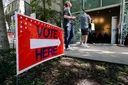



The 2024 exit polls made the structural weakness undeniable. For the first time since exit polling began, Republicans outnumbered Democrats in party identification among actual voters, 35 percent to 31 percent, with independents at 34 percent.
Gallup’s full-year 2024 data confirmed it: Republicans held a one-point edge in party affiliation when independent leaners were included.
The Democratic coalition had measurably shrunk, losing ground among Hispanic voters, younger men, and working-class voters without college degrees, all groups that had been reliably Democratic for a generation.
The ‘Not Trump’ ceiling
The brand problem has a specific shape. Since 2016, the Democratic Party’s central message has essentially been: we are not Trump.
That message has sometimes worked and sometimes failed, and the pattern of when it works and when it fails is revealing.
The ‘Not Trump’ reliance against a positive agenda has not always worked.
Democrats won in 2018 and 2020 on the ‘Not Trump’ message, but lost in 2016 and again in 2024, two elections where a party with a compelling affirmative agenda should have done better.
The 2022 midterms are the most relevant cautionary tale. Democrats were polling four to five points ahead on the generic ballot that spring.
The Dobbs decision had energised their base. Most forecasters expected a wave. Instead, Republicans held the House. The ceiling held.
A CNN poll has found that more than three-quarters of voters planning to support Democrats describe their vote as a message of opposition to Trump, nearly the same dynamic as in 2022.
The structural environment is worse for Republicans now than it was then, but the Democratic message is no more affirmative.
How brand weakness changes the numbers
When Democratic brand weakness is built into the model as a quantifiable variable, it functions as a systematic drag on what the favourable environment would otherwise produce.
The structural environment alone, based purely on approval ratings, the generic ballot, and economic anxiety, would predict roughly 248 Democratic House seats.
The brand penalty reduces that to around 225. That gap of 23 seats is the difference between a commanding majority and one that hangs by a thread.
The Senate math tightens in the same way. Jon Ossoff in Georgia, the only Democratic incumbent running for re-election in a state Trump carried in 2024, becomes very difficult to protect in any scenario where the brand problem persists.
Flipping Maine, North Carolina, and Michigan while holding Georgia is achievable. It is not guaranteed.
The bottom line
Democrats are favoured to win the House in November 2026, with that probability sitting at roughly 55 to 62 percent across current polling.
The Senate sits at around 50 to 55 percent, a genuine toss-up. Both numbers are meaningfully lower than the raw political environment would suggest, and the gap is almost entirely explained by the brand problem.
The most consequential question between now and November is not whether Trump’s approval falls or whether gas prices ease.
It is whether Democrats give voters a reason to vote for them rather than simply against him.
The ‘Not Trump’ strategy has a ceiling. History shows exactly where that ceiling is.
Whether Democrats bump against it again in 2026, or finally break through it, will determine not just how many seats they win, but whether a majority built on opposition alone can hold together once they have it.
Methodology: Seat projections use four weighted variables: presidential approval (40%), generic ballot lead (30%), economic anxiety (20%), and Democratic enthusiasm differential (10%). A brand weakness adjustment of minus 20 to 23 House seats and minus 2 Senate seats is applied based on current Democratic favourability data relative to historical baselines. Structural adjustments: +3.5 seats (Virginia redistricting), minus 4 seats (gerrymandering/VRA).