It began as a satirical online project. Now millions of young Indians are flocking to it as an outlet for their frustration.
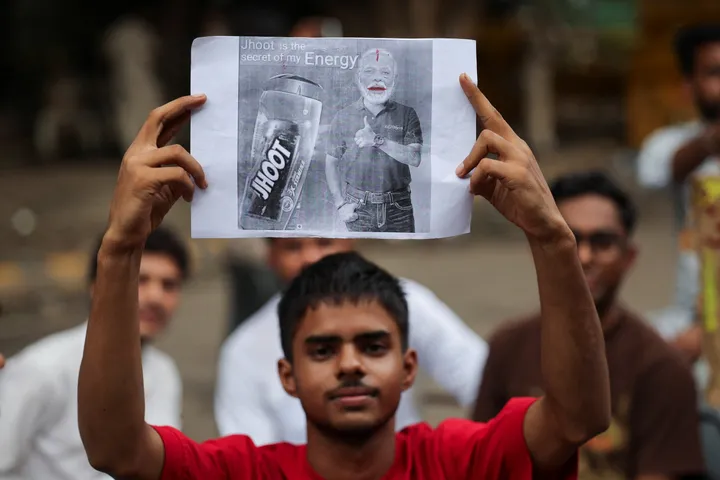
A parody political party called the Cockroach Janta Party, with the insect as its symbol, has exploded across India's social media by turning absurdist humour into protest.
Memes and short videos mocking corruption, joblessness and political dysfunction under Prime Minister Narendra Modi's Bharatiya Janata Party (BJP) have flooded social media sites, where millions of users are embracing the cockroach — known for its ability to survive harsh conditions — as a tongue-in-cheek symbol of endurance.
The online movement's rise has been unusually rapid.
The Cockroach Janta Party, or CJP, set up its website and social media accounts on Saturday.
By Thursday, its Instagram page had amassed more than 18 million followers, far surpassing the 8.8 million followers of Prime Minister Narendra Modi's governing Bharatiya Janata Party on the platform.
"Nothing of this was intentional," CJP founder Abhijeet Dipke told The Associated Press, saying the movement's rise reflected mounting frustration among young Indians under the right-wing ruling party.
"It is the younger people who were actually very frustrated. They didn't have any outlet. They were really angry at the government," said Dipke, a political communications strategist and Boston University student.
Courtroom remark led to viral parody movement
The CJP emerged online after remarks by Supreme Court Chief Justice and Modi ally Surya Kant triggered backlash among young Indians angered by unemployment, rising living costs and recent government exam paper leaks that have disrupted job recruitment drives.
During a hearing last week, Kant criticised what he described as "parasites" attacking institutions and compared some unemployed young people and activists to cockroaches.
"There are youngsters like cockroaches, who don't get any employment or have any place in the profession," Kant said. He said that some turned to social media activism, journalism or public interest campaigns and "start attacking everyone."
The comments quickly spread online, where many users saw them as dismissive. Kant later clarified that his remarks referred to people obtaining fraudulent degrees and said that he didn't intend to insult India's youth.
But the controversy soon led to the creation of the parody CJP account on Instagram, which adopted the cockroach as its political symbol and began posting memes, mock campaign slogans and satirical commentary targeting Modi's government.
Within days, it drew tens of thousands of online volunteers through a Google form submission, alongside endorsements from some opposition leaders.
"We have to understand that five years ago nobody was ready to speak up against Modi or the government. The times are changing," said Dipke, who has previously worked with the Aam Aadmi Party, which emerged from India's anti-corruption movement in 2012.
CPJ taps into wider youth discontent
Dipke said that the CPJ isn't affiliated with any real political organisation.
But its rise echoes a broader trend across South Asia, where youths have played a central role in anti-government movements in recent years, including uprisings in Sri Lanka and Bangladesh and unrest in Nepal.

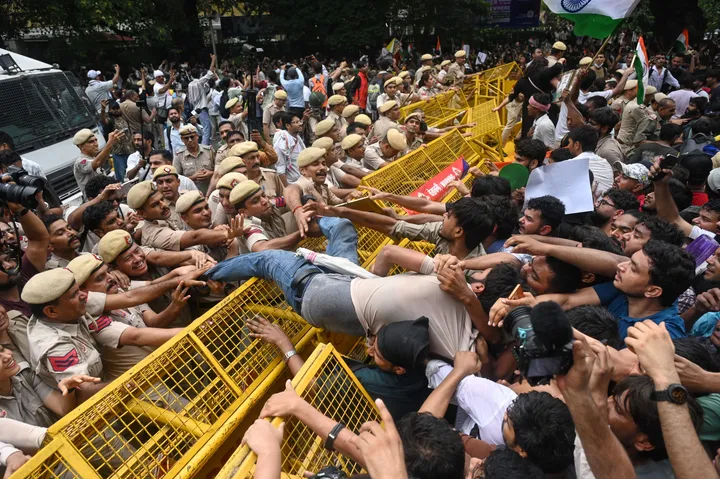




"The youth are really frustrated, and the government is not acknowledging their concerns," Dipke said.
Dipke told Reuters news agency that, "The youth of India has largely vanished from the mainstream political discourse. Nobody is talking about us. Nobody is listening to our issues or even trying to acknowledge our existence."
The pressures are especially acute in India, where youth make up more than a quarter of the population, yet many young people face scarce job opportunities, persistent unemployment and growing frustration with traditional political parties.
Many young voters are also angry with Modi's ruling Hindu nationalist party over issues including rising religious polarisation, widening inequality and economic pressures.
Dipke, however, cautioned against comparisons with Gen Z-led street protests in neighbouring Bangladesh and Nepal that have ousted governments and declined to say whether there were plans to form a Gen Z political party.
"It has the potential to turn into a big political movement, it has the potential to change the politics of India," he said.
"And whatever we do, we will do within the rights of the constitution. We will do it in a very democratic and peaceful way. It won't be something like we saw in Nepal or Bangladesh."
Absurdist rules and a serious subtext
The CJP leans heavily into self-mockery.
Its tongue-in-cheek membership criteria include being unemployed, lazy, chronically online and capable of ranting professionally.
Its manifesto uses satire to address several contentious issues in Indian politics, including opposition allegations of voter manipulation, criticism of the relationship between corporate media and the government, and the appointment of retired judges to official posts.
Some opponents, many of them Modi supporters, have dismissed it as an online political gimmick aligned with the opposition, citing Dipke's past association with the Aam Aadmi Party. They also say that the surge in popularity is likely to fade as quickly as it emerged, arguing that it's a digital campaign rather than a grassroots movement.
But Dipke said what began online was unlikely to remain confined to social media.
"This is the movement that has arrived in India … it will change the political discourse," he said. "It will continue online, and if required, it will also come on the ground."
"I really like the Cockroach Janta Party because in this country no one listens to the voice of the youth and there are not enough jobs for young people," said Siddharth Kanaujia, a 26-year-old from the northern city of Lucknow who has signed up to become a CJP member.
"But the party talks in the interest of the youth and raises the right issues The cockroach reflects resilience, coming back strongly after every challenge."
Pushback begins as parody spreads offline
The movement has already begun to slowly spill offline, with some young volunteers appearing at protests dressed as cockroaches.
So has the apparent pushback.
On Thursday, Dipke wrote on X that the CJP's account on the platform, which had around 200,000 followers, had been withheld in India, marking one of the first visible restrictions of the rapidly growing parody movement. The reason wasn't immediately clear.
Minutes later, Dipke announced a new account for the group, alongside a poster reading "Cockroach is back."
The post added: "You thought you can get rid of us? Lol."