 Saad Hasan
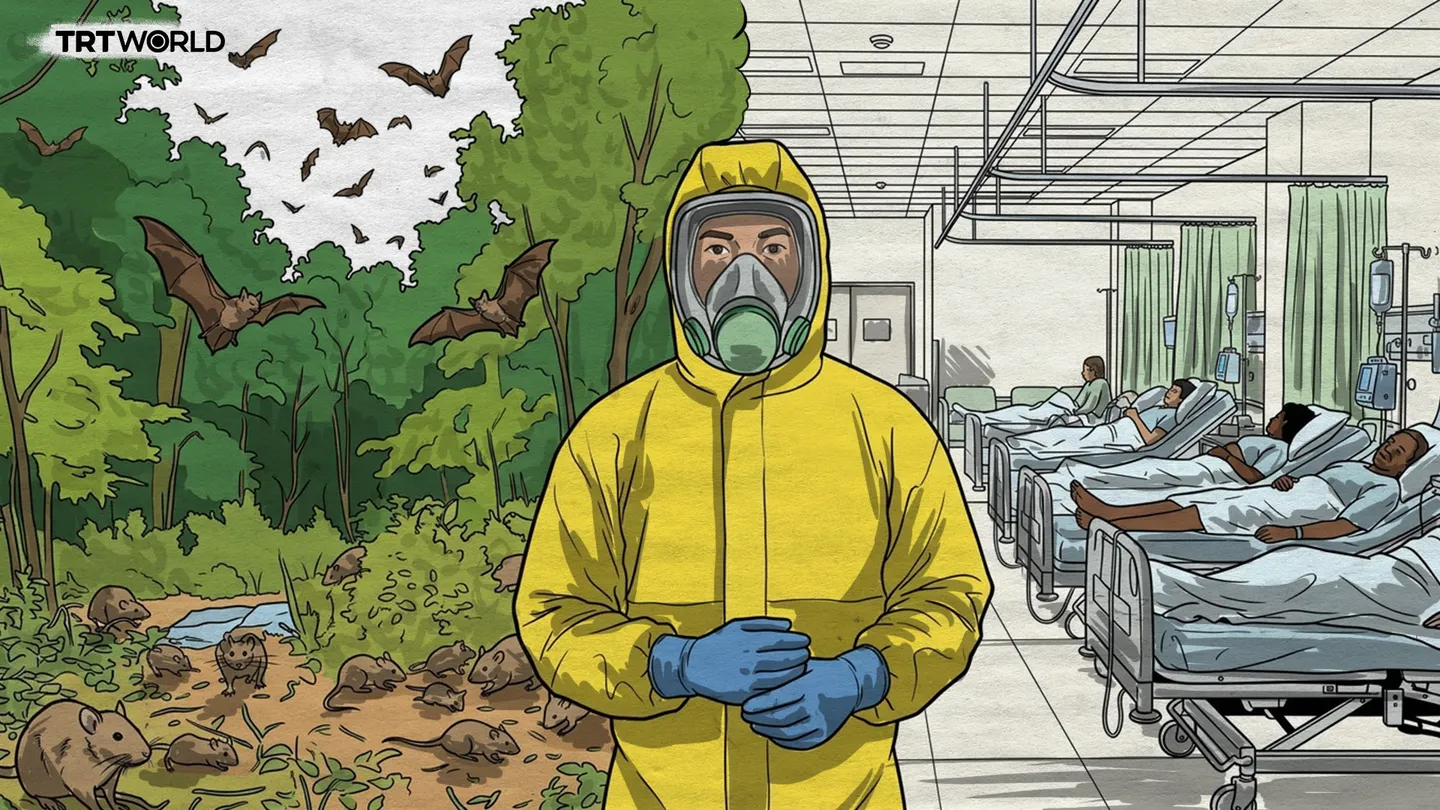
Since 1976, when Ebola was first identified as a zoonotic disease, scientists have trapped and studied thousands of different animals, including bats, rats, snakes and even insects, as they try to find the origin of the virus. They have hit a dead end every time.
As health authorities in the Democratic Republic of Congo (DRC) and Uganda try to contain the latest outbreak, virologists are once again pondering the question of the elusive reservoir, the animal that carries the virus and then spreads it to other animals and humans.
Professor Alexander Bukreyev, the Associate Director of the Centre for Biodefense and Emerging Infectious Diseases at the University of Texas Medical Branch, says the best way to understand this dilemma is to see how the source of a similar virus was discovered.
Marburg, like Ebola, is part of the filovirus family. A deadly pathogen was found in Egyptian fruit bats at the Kitaka gold mine in Uganda in 2007-08.
What has since been established is the fleeting nature of Marburg, meaning the virus doesn’t stay in bats for long. The researchers were lucky to identify the Marburg reservoir because they collected bat samples shortly after an outbreak.
“The infection is transient. So the Egyptian fruit bat acquires the virus, maintains it for a certain time and then it’s cleared completely,” Bukreyev tells TRT World.
“This spreads through the community of bats, but it doesn’t stay for a long time in any single animal.”
Like Marburg, Ebola also plays this hide-and-seek game in the darkest depths of nature.
The vanishing act
Around 60 percent of all infectious diseases originate from animals in the wild. Much is still unknown about these zoonotic diseases, including which ecological and environmental factors contribute to outbreaks in the first place.
The latest outbreak of the Bundibugyo strain of Ebola virus in the DRC and neighbouring Uganda has killed 63 people, according to the World Health Organization.
Identifying the reservoir is important for epidemiologists, as it helps determine where the animal lives and how it can come into contact with humans or other animals that can spread the disease.
“If I knew for certain that four species of fruit bat were the most important wild reservoirs, I could make really accurate maps that take into account where they live and details of their life history and day-to-day habits,” says Patrick R Stephens, Associate Professor, Department of Biology at Oklahoma State University.
“I could also predict new areas the viruses might spread to if any of those species were able to expand their range. It also helps us decide which wild mammals we should perhaps be monitoring to anticipate flare-ups in ebolaviruses,” he tells TRT World.
In 1963, an outbreak of Machupo virus, which causes hemorrhagic fever, ripped through rural Bolivia. Ecologists found that a native mouse was a natural reservoir for the virus.
“Trapping out the virus effectively ended the virus,” writes David Quammen in his seminal book on zoonotic diseases, Spillover.
The gold standard for identifying the reservoir is to isolate a live virus from that animal so that it can be cultured in a laboratory.
Ebola antibodies and RNA have been detected in several bat species and other animals from time to time. But that’s not good enough since antibodies only show that the animal might have had the virus at some point in its lifetime. Researchers are lucky even to find antibodies in any case.








“You get cold at least once every few years, right? But if I pick a random day of your life and sample you for a cold virus, I probably won’t find it, right? Even if I look for antibodies, depending on what strains you have been infected with, how long ago, and what antibody test I use, I still might not find it,” says Stephens.
“So consider issues like that with wild mammal species we barely know anything about, and you will see what a tough problem it is.”
The viral needle points nowhere
In the past five decades, multiple outbreaks in DRC, Gabon, Liberia, Sierra Leone, Sudan, Uganda, and other countries have killed thousands of people.
Yet not enough has been done to search for the animal or animals primarily responsible for Ebola spillover into humans.
Based on where the past Ebola outbreaks have occurred and tracking of infectious cases, scientists are convinced that the Ebola source lives in the wild. They also believe it's a mammal.
Stephens says that of the 900 known species of mammals in Africa, only about 350 have been sampled. Even fewer have been infected with a live virus in a laboratory, which allows researchers to see where the virus hides inside an animal and how long after the infection it becomes detectable.
“The virus is also likely pretty rare in the species that it does infect. For example, in most species where we have found it, only two or three individuals have ever tested positive out of however many samples, sometimes hundreds.”
What Stephens is talking about is finding antibodies.
Most of the past outbreaks, such as the deadly spillover in 2014 that killed more than 11,000 people in Sierra Leone, Liberia and Guinea, have been traced back to wild animals.
In the 2014 outbreak, virologists found that the first infection was a two-year-old boy who may have come in contact with bats in Guinea. Other outbreaks have been linked to the consumption of meat from dead chimpanzees and other primates.
Even considering that the search for the Ebola virus has been limited to a small percentage of wild animals, it is mind-boggling that no trace of live virus has been found despite hundreds of samples that have been meticulously collected from jungles of DRC and other places and then shipped to high-tech labs of institutions like America’s CDC.
Maybe that’s because remnants of the virus hide in some tissue of an animal after the outbreak has run its course, Stephens and his colleagues argued in a paper titled ‘Where is the elusive primary ebolavirus reservoir and how do we find it?’
The immune system of animals, like that of humans, fights and flushes out pathogens. But a tiny bit of the infection might still remain in the body, lingering in a tissue, eluding virologists.
The paper argued that once the animals experience any stress, such as food shortages, it triggers the virus to resurface.
Even if scientists narrow their search to bats, collecting samples from thousands of bats across different species is a daunting and expensive proposition.
“Add on top of that the fact that if you sample at the wrong time of year or sample the wrong tissue, you still won’t find it, and you have a really tough task in front of you. So few species have been studied in detail in the lab that it’s really hard for us to narrow any of that stuff down,” says Stephens.
“Of course, ultimately the main reason we haven’t found it more often is because there just isn’t money available to look for it. Certainly not the kind of money you would need to thoroughly sample hundreds of species.”