 Murat Sofuoglu
Israel's October election will test not only President Benjamin Netanyahu's political future but also the transformation of his Likud party, once regarded as a mainstream force in Zionist politics and now increasingly viewed by analysts as part of Israel's far-right camp.
While the Israeli left dominated Zionist politics from Israel's establishment in 1948 until 1977, its grip on power steadily weakened after Likud's rise under Menachem Begin, the former prime minister of Israel.
Aside from brief periods under left-wing and centrist governments, Israeli politics since the 1990s has largely been shaped by Likud-led coalitions.
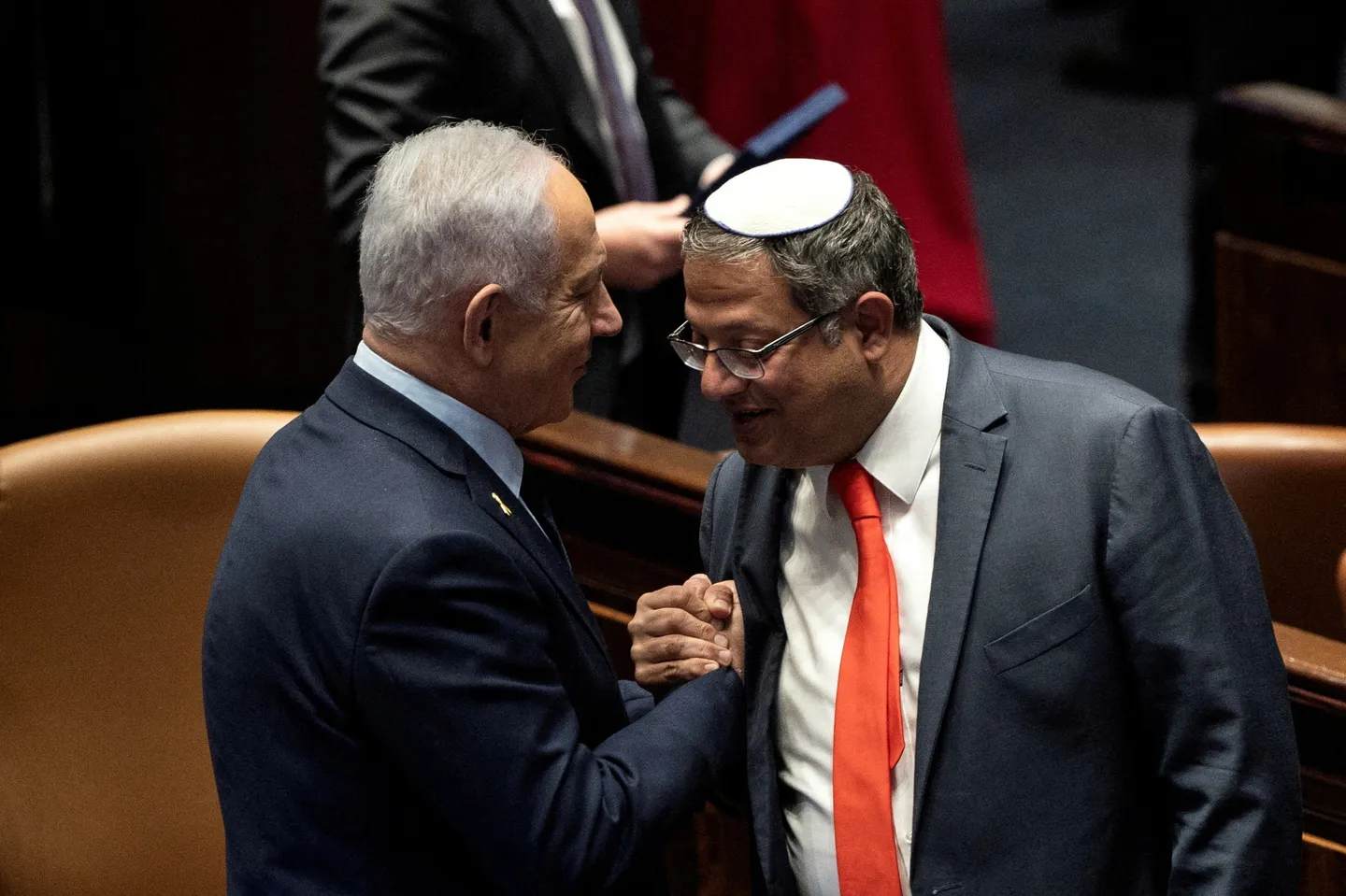
Under Netanyahu, Israel's longest-serving prime minister, Likud has increasingly aligned itself with far-right parties such as Itamar Ben-Gvir's Jewish Power and Bezalel Smotrich's Religious Zionism, adopting positions once associated with the political fringe, including the annexation of occupied Palestinian territories and the idea of Greater Israel.

While Likud, an abbreviation for the National Liberal Movement, has long been regarded as a mainstream party with secular credentials, its shift towards far-right positions has cast a dark shadow over its own future and Israeli politics, according to experts.
"There is no significant distinction between the policies and ideology of Likud and the far-right parties," Dahlia Scheindlin, a political scientist and senior analyst at Haaretz and author of The Crooked Timber of Democracy in Israel: Promise Unfulfilled, tells TRT World.
"Netanyahu is often seen as someone who is not ideologically a religious fundamentalist or annexationist, but this distinction no longer matters since the Likud has thrown its full support behind the policies of the most fanatic parties," she says, referring to his coalition partners.
Both Ben-Gvir and Smotrich advocate the annexation of occupied Palestinian territories.
Ben-Gvir has also attracted controversy for statements ranging from calling on the Israeli military to kill dozens of Palestinians in Gaza each day to proposing a ditch filled with crocodiles around prisons holding Palestinian detainees.
Despite Netanyahu's continued alliance with the far right, Scheindlin believes Likud faces a more difficult election than in previous years.
Most opinion polls, she says, suggest the party has fallen behind the centrist Yashar party led by former military chief Gadi Eisenkot.
Recent polls indicate that Netanyahu's hardliner bloc has 50+ seats, well short of the 61 seats required for a parliamentary majority to form a government and rule Israel.
However, Likud and its far-right allies remain relevant in Israeli politics, as election dynamics can shift with regional developments.
Why shifting to the far-right
Likud was co-founded in 1973 by Menachem Begin of the Irgun, a Zionist underground group attacking British and Palestinian forces before Israel’s 1948 founding, and later led by Ariel Sharon, a former general and another co-founder of the party, has recently become more extremist.

“Likud has been shifting. First, it has become centred around Netanyahu, whose loyalists are filling the ranks. Then, it has also shifted towards populism and far-right,” Nimrod Goren, President of the Mitvim Institute, an Israeli think tank, tells TRT World.
“It is now a very different party from the more liberal party it used to be in previous decades. In response, quite a number of long-time Likud members have left the party and joined or established other right-wing parties.”
Most recently, Yuli Edelstein, a senior lawmaker, left Likud in protest of the Netanyahu government’s bill to exempt ultra-Orthodox Haredi Jews from military service.
Earlier this month, Dan Illouz, a Likud deputy, also quit the party on the same grounds, refusing to vote for the military exemption bill, which easily became a law.
Goren argues that Likud’s shift has been driven not only by ideology but also by political circumstances and Netanyahu’s legal troubles, which have made him dependent on extremist parties.
He also argues that “Netanyahu's deviation from good governance and liberal democratic practices” has made Likud and the far-right parties, once regarded as political outcasts, “more of a fit”.
Analysts also point to the growing influence of populism within Likud.
Under Netanyahu, they say, the party has become increasingly centred on his personal leadership rather than its traditional ideological platform.
“Netanyahu clearly controls the path Likud goes in,” says Goren, adding that the Israeli leader has been granted by the party the right to personally name one third of the candidates expected to enter parliament.
“This reflects his significant control over the party.”
Other experts also believe that Netanyahu’s survival instincts, as much as ideological reasons, have pushed him to the brink of allying with Ben-Gvir and Smotrich.








“I do not think that Likud has itself become a far-right party. It would be more accurate to say that it has undergone two significant changes in recent years,” Arik Rudnitzky, a researcher at the Moshe Dayan Center for Middle Eastern and African Studies.
“First, it has adopted a populist political discourse that emphasizes Netanyahu’s personality and leadership more than Likud’s positions on political and social issues. Second, Likud has tied its political fate to far-right parties as well as to the ultra-Orthodox parties, primarily to secure its ability to form a governing coalition,” Rudnitzky tells TRT World.
“Some of Likud’s direct rivals in the opposition have not ruled out forming a national unity government with Likud after the next election, subject to certain conditions. This suggests that Likud is still not widely perceived as a far-right party, despite its prolonged coalition partnership with far-right parties.”
Has Likud long flirted with extremism?
Not all analysts agree that Likud's shift to the far right is solely a product of Netanyahu's leadership.
Some argue that the party's ideological roots have always been closely linked to Revisionist Zionism, a nationalist movement founded by Ze'ev Jabotinsky that advocated Jewish sovereignty over the whole of historic Palestine and rejected territorial compromise.
“In The Fall of Israel (2024), I used Netanyahu's family genealogy to demonstrate his links - through his father's views and support of Ze’ev Jabotinsky's revisionism - to a hardline stance that was suppressed in Israel until Menachem Begin's electoral triumph in the late 1970s,” Dan Steinbock, an expert on geopolitical conflicts and Israeli history, tells TRT World.
Netanyahu's father, Benzion Netanyahu, worked as an assistant to Benjamin Akzin, Jabotinsky's personal secretary.
Jabotinsky's ideas also shaped the Irgun.
For Steinbock, those historical links suggest that Likud's relationship with the far-right predates Netanyahu.
“I argued that Likud has flirted with the Israeli far-right since its founding. With Netanyahu, this courting has intensified since the assassination of Prime Minister Isaac Rabin over two decades ago,” Steinbock says, referring to the 1995 killing of the leftist leader, who signed a peace deal with the leadership of the Palestinian Liberation Organisation.
“By accommodating the Messianic far-right since the 2010s, and violent settlers since the 1980s, Likud has long been close to the far-right. But until Netanyahu, Likud leaders kept their distance from far-right extremists. That's not the case anymore,” he says.
According to Steinbock, Netanyahu's decision to bring far-right parties into government after the 2022 election marked a decisive turning point.
“When Netanyahu invited the Messianic far-right into his coalition in 2022/23, what had been effective for years became official. The net effect is the devastation in Gaza, the West Bank and the broader Middle East we witness today.”
Steinbock also highlights decades of US support for Netanyahu, which has helped secure his long-term power in Israel.
“Netanyahu would be an empty balloon without the massive arms transfers and financing from US governments, the White House, and the ultra-conservative Israel Lobby. To understand the secret of his success, follow the money,” he says.
If Likud wins
Analysts say the outcome of October’s election could shape not only Israel’s political future but also its civic institutions and relations with Palestinians and the wider Middle East.

For Scheindlin, the consequences of another Netanyahu-led far-right government are already visible.
“We're seeing the results every day since this government was established. Destruction of democratic institutions, catastrophic failures on security due to distraction and dysfunction, wrongful policies and extremist policies, failed wars, diplomatic isolation, growing ultranationalist violence that could one day go beyond the control of the state,” warns Scheindlin.
Even if Likud does not move fully to the far right, “Israel's future trajectory will be grim” if Netanyahu forms a government with far-right and ultra-Orthodox parties, according to Goren.
But the Israeli public seems to acknowledge this and thus prefers a different type of coalition and leadership, he adds.
Independent of Likud’s election prospects, if Likud becomes part of the Israeli far-right, the party might lose its powerful influence over Israeli society, according to Rudnitzky of the Moshe Dayan Center.
“If Likud were to adopt an explicitly far-right rhetoric and political worldview, it would risk being relegated to the margins of Israeli politics. Although far-right parties entered government following the 2022 election, the broader Israeli public does not necessarily identify with their worldview,” he says.
As a result, Likud’s possible far-right shift could end the party’s “dominant position in Israeli politics and create opportunities for alternative political forces, such as Naftali Bennett’s Beyahad party or Gadi Eisenkot’s Yashar party,” he says.
“These parties seek to present themselves as representatives of the ‘true, mainstream traditional right’—one that rejects radicalism and is prepared to promote regional peace and stability.”