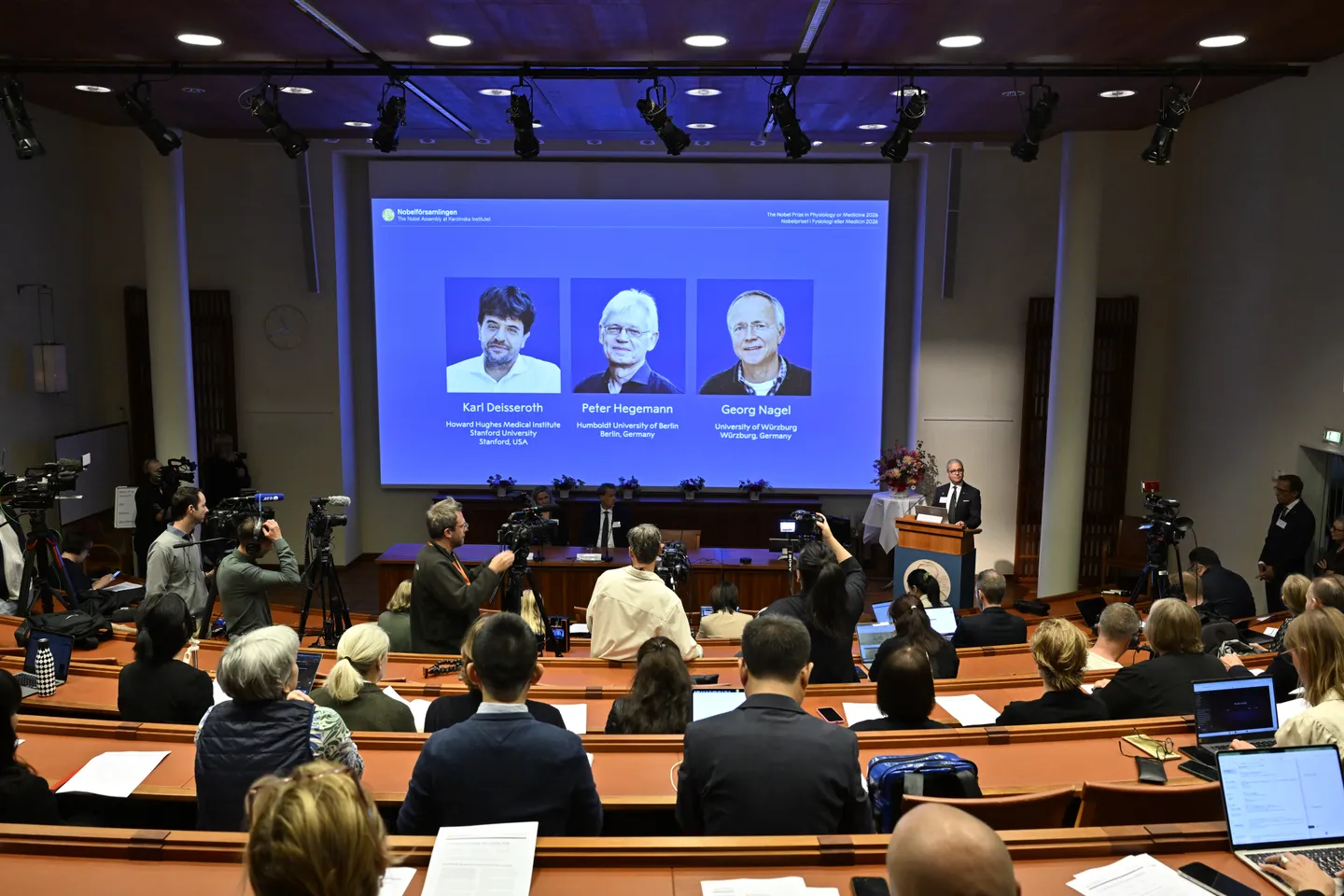
The 2026 Nobel Prize in Physiology or Medicine has been awarded to US psychiatrist and neurologist Karl Deisseroth and German scientists Peter Hegemann and Georg Nagel for discoveries that laid the foundation for optogenetics, a technique that allows researchers to control nerve-cell activity with light.
The Nobel Assembly honoured the trio for their discoveries concerning light-gated ion channels and optogenetics, a field that has fundamentally changed the study of the brain.
By combining genetics with light, scientists can activate or silence specific groups of nerve cells, allowing them to investigate how individual neural circuits contribute to processes such as learning, fear, addiction and movement.

From algae to the living brain
The breakthrough began in the early 2000s, when Hegemann and Nagel were studying how single-celled algae detect and move towards light.
They identified a light-sensitive protein called channelrhodopsin. When exposed to blue light, the protein opens a channel that allows charged particles to enter the cell, generating an electrical signal.
Deisseroth later introduced the gene responsible for channelrhodopsin into nerve cells. In 2005, he demonstrated that blue light could trigger nerve signals in those cells, and by 2007 the technique had been used to control neurons in the brains of living mice.
The discoveries gave neuroscientists a powerful way to investigate the brain with unprecedented precision.








“Optogenetics provides opportunities for mapping the brain in a way that we could once only dream of,” said Per Svenningsson, chair of the Nobel Committee.
A tool with medical potential
The technique has helped researchers identify neural circuits associated with memories, emotions and behaviours that are relevant to neurological and psychiatric disorders.
Its use in humans remains highly limited, but optogenetic approaches have begun moving towards clinical applications, including research aimed at treating certain forms of blindness. Scientists are also studying its potential for conditions such as Parkinson’s disease and epilepsy.
Deisseroth, 54, is a professor at Stanford University. Hegemann, 71, is a neuroscience professor at Humboldt University of Berlin, while Nagel, 73, is a biophysics professor at the University of Würzburg.
The three laureates will share a prize of 12 million Swedish kronor, with the awards to be formally presented in December.
When Nobel Assembly Secretary General Thomas Perlmann called the scientists to tell them they had won, all three expressed their delight at sharing the prize, saying they considered it “absolutely wonderful” to receive the honour together.
The award recognises a scientific breakthrough that has moved neuroscience closer to understanding how individual cells and circuits shape the complex workings of the brain.